Arduino UNO Q
- Arduino UNO Q 02016 (2GB RAM + 16GB eMMC)
- Arduino UNO Q 04032 (4GB RAM + 32GB eMMC)
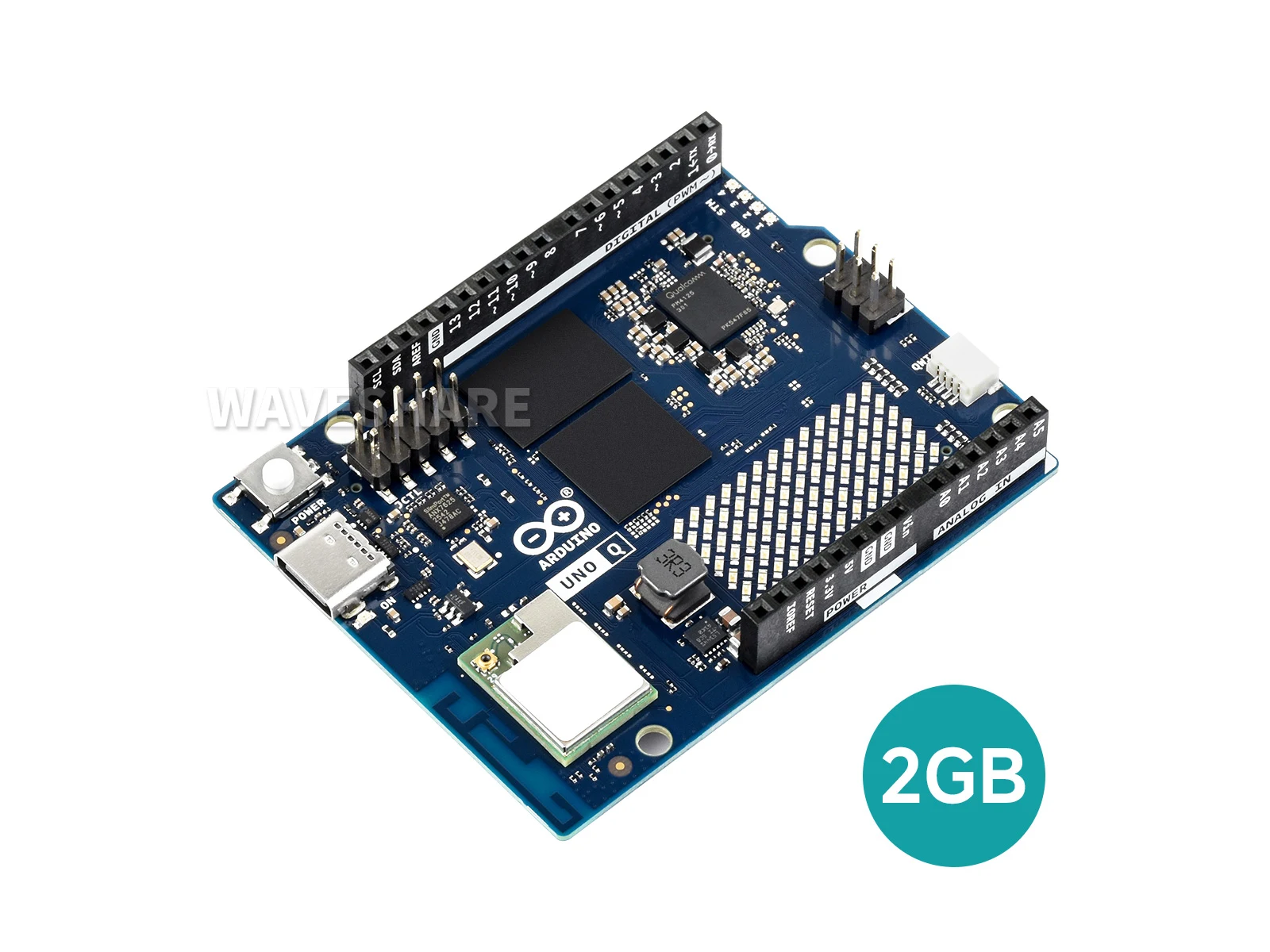
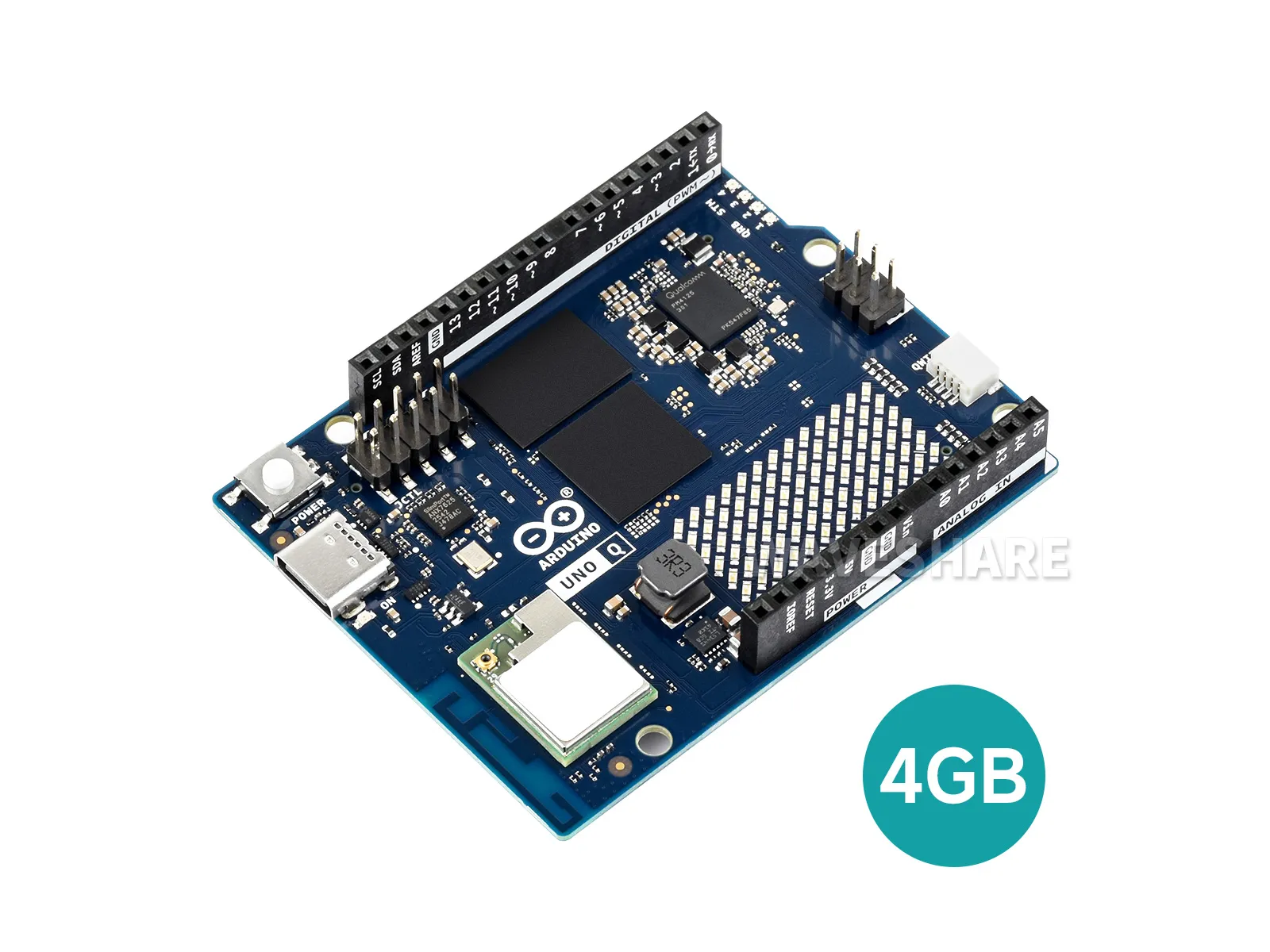
The Arduino UNO Q is a dual-architecture single-board computer that integrates a Qualcomm Dragonwing QRB2210 microprocessor (MPU) with an STMicroelectronics STM32U585 microcontroller (MCU) in the classic UNO form factor. The MPU runs a full Debian Linux system, suitable for AI, machine vision, networking, multimedia, and high-level applications; the MCU runs Arduino Core on Zephyr OS, suitable for real-time I/O, low-power control, and traditional Arduino Sketches.
Communication between the Linux system and the microcontroller is handled by the Arduino Bridge (RPC, Remote Procedure Call). Developers can combine Python/Linux applications, Arduino programs, and AI models in the same project, allowing high-level computing and real-time control each to do what they do best.
| SKU | Product |
|---|---|
| 34606 | Arduino UNO Q 02016 |
| 34607 | Arduino UNO Q 04032 |
Features
- Dual-architecture design: Linux MPU handles high-performance computing, MCU handles real-time control.
- Qualcomm Dragonwing QRB2210 quad-core Arm Cortex-A53 MPU, up to 2.0GHz, with Adreno GPU and dual ISP.
- STM32U585 MCU, Arm Cortex-M33 core, up to 160MHz, with 2MB Flash and 786KB SRAM.
- Supports Debian Linux and Arduino Core on Zephyr OS.
- Supports Arduino App Lab, integrating Python applications, Arduino Sketches, and AI models in one workflow.
- Supports Arduino IDE 2.x and Arduino CLI for MCU-side development.
- Built-in eMMC storage and LPDDR4X memory, available in 2GB/16GB and 4GB/32GB combinations.
- Dual-band Wi-Fi 5 (2.4/5GHz) and Bluetooth 5.1, with onboard antenna.
- USB-C port supports power supply, host/device mode switching, and video output.
- Compatible with the classic UNO form factor, works with Arduino shields, carrier boards, Modulino nodes, and third-party expansions.
- Onboard 8 × 13 LED matrix, RGB LED, user button, power button, and hardware debug UART.
Specifications
| Parameter | Specification |
|---|---|
| Microprocessor (MPU) | Qualcomm Dragonwing QRB2210, quad-core Arm Cortex-A53 @ 2.0GHz; Adreno GPU 3D graphics acceleration; 2 × ISP, up to 25MP @ 30fps |
| Microcontroller (MCU) | STM32U585, Arm Cortex-M33, up to 160MHz; 2MB Flash, 786KB SRAM |
| System | Debian Linux; Arduino Core on Zephyr OS |
| Memory | 2GB or 4GB LPDDR4X |
| Storage | 16GB or 32GB eMMC |
| Wireless Connectivity | Wi-Fi 5 dual-band 2.4/5GHz; Bluetooth 5.1; onboard antenna |
| USB | 1 × USB-C, supports power delivery, host/device mode switching, and video output |
| Power Supply | USB-C up to 5V/3A; VIN pin 7V ~ 24V |
| Video | USB-C video output, supports Full HD (1920 × 1080p) displays |
| Audio | JMISC interface supports microphone input, headphone output, line output, and earpiece output |
| Communication Interfaces | USART, UART, I2C, SPI, CAN, SAI, PSSI |
| Typical Applications | Prototyping, edge AI/machine learning, machine vision, education, smart devices, robotics, home/building automation, gaming |
| Dimensions | 68.85 × 53.34 (mm) |
| GPIO Level | MCU GPIO is 3.3V logic; most MCU GPIOs are 5V tolerant except A0 and A1 |
Architecture Overview
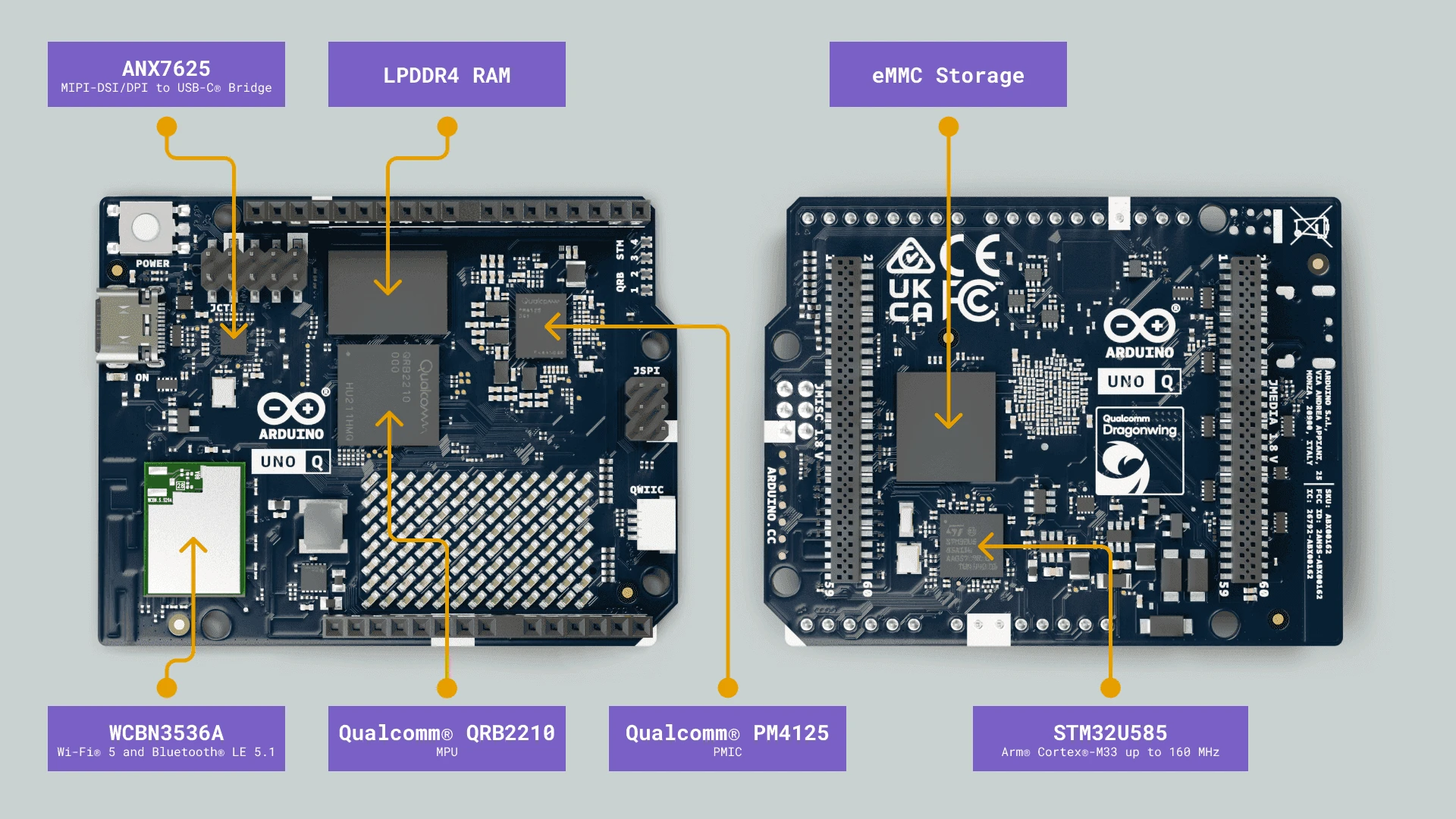
Below is an overview of the main components of the UNO Q, as shown in the figure above:
-
Microprocessor (MPU): Features a Qualcomm QRB2210 quad-core Arm Cortex-A53 processor running at up to 2.0 GHz, with an integrated Adreno 702 GPU supporting 3D graphics acceleration. It also features dual ISP, supporting up to 25 MP@30 fps image processing capability. The system runs Debian Linux, suitable for embedded vision, edge computing, AI inference, and high-level application development.
-
Microcontroller (MCU): Features an STM32U585 microcontroller based on the Arm Cortex-M33 core, running at up to 160 MHz, with 2 MB Flash and 786 KB SRAM. This MCU runs Zephyr OS, suitable for sensor acquisition, actuator control, low-latency I/O, and low-power embedded applications.
-
Wireless Connectivity: Onboard WCBN3536A wireless module supporting dual-band Wi-Fi 5 (2.4 GHz / 5 GHz) and Bluetooth 5.1, with an onboard antenna for stable and reliable wireless connectivity.
-
Storage & Memory: Available with 16 GB or 32 GB eMMC storage options, and 2 GB or 4 GB LPDDR4 RAM options, meeting the needs of embedded systems for system storage, application execution, and data caching.
-
Multimedia Codec: Onboard ANX7625 multimedia codec supporting video and audio output via the USB-C connector, providing high-speed interfaces for display and sound transmission.
-
Power Management: Integrates the Qualcomm PM4145 Power Management IC (PMIC), providing stable power to various functional modules and meeting the power management requirements of continuously operating connected IoT devices.
Interface Description
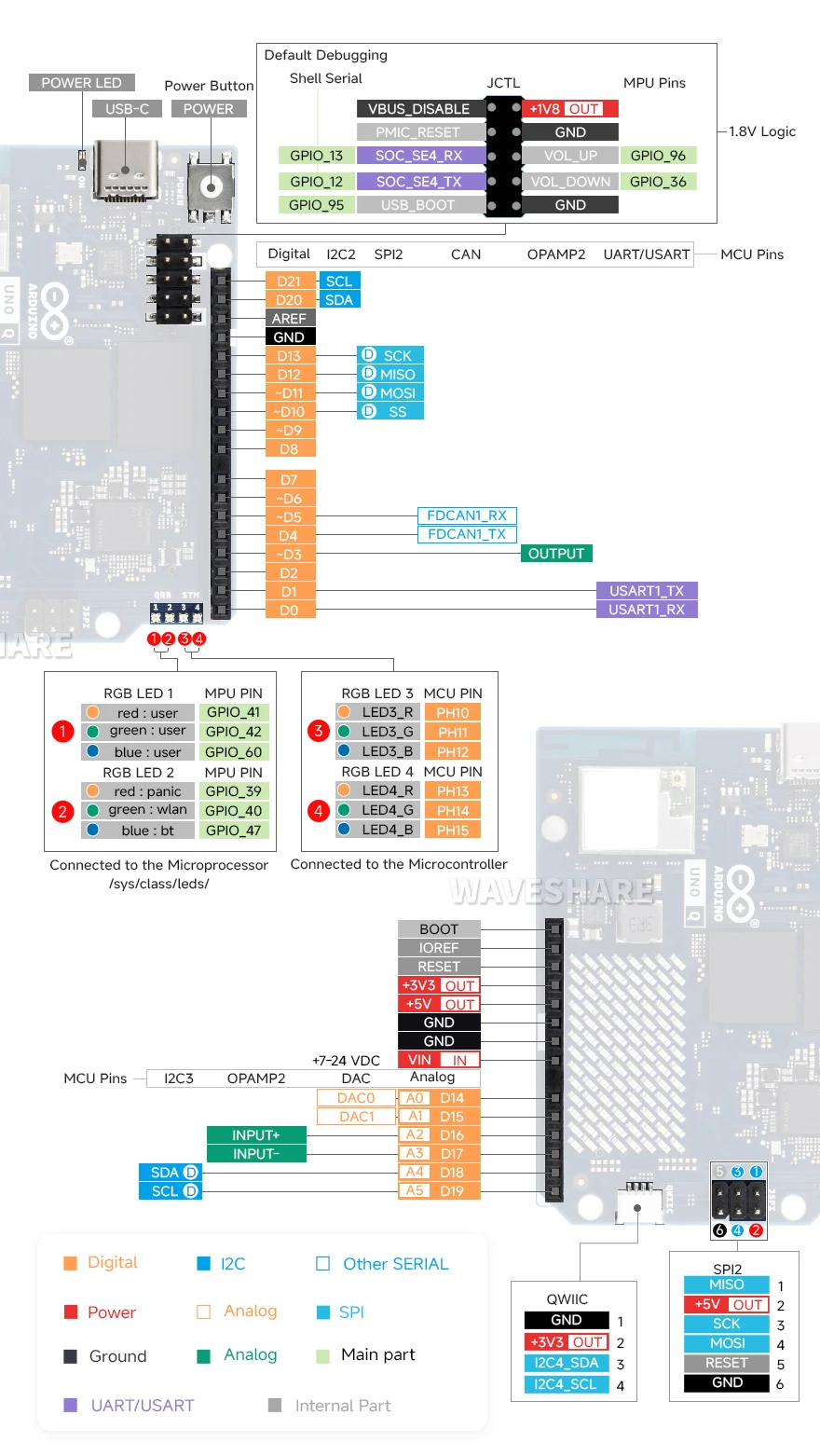
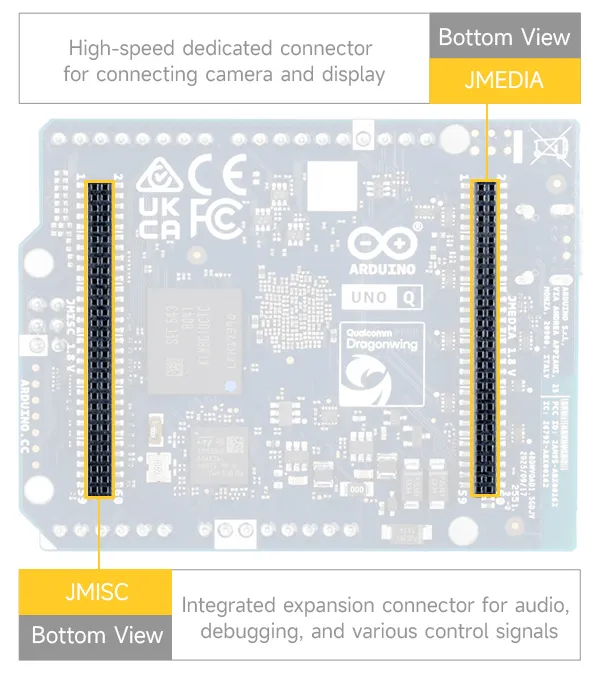
Except for the A0 and A1 pins (which are not 5V tolerant), the MCU GPIO pins are 3.3V logic and are 5V tolerant. Verify the voltage range before connecting external circuits.
The complete pinout diagram can be downloaded from the official resources:
Form Factor and Dimensions
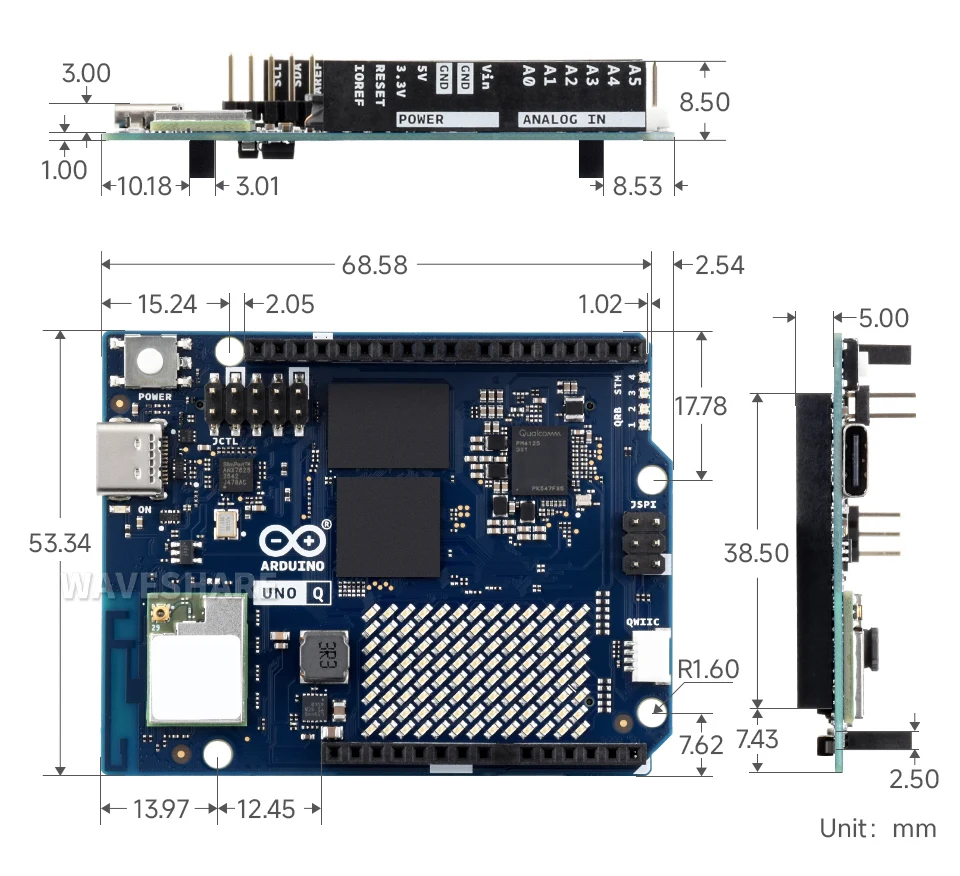
UNO Q retains the classic UNO form factor, making it compatible with a large number of UNO shields, carrier boards, and expansion modules.
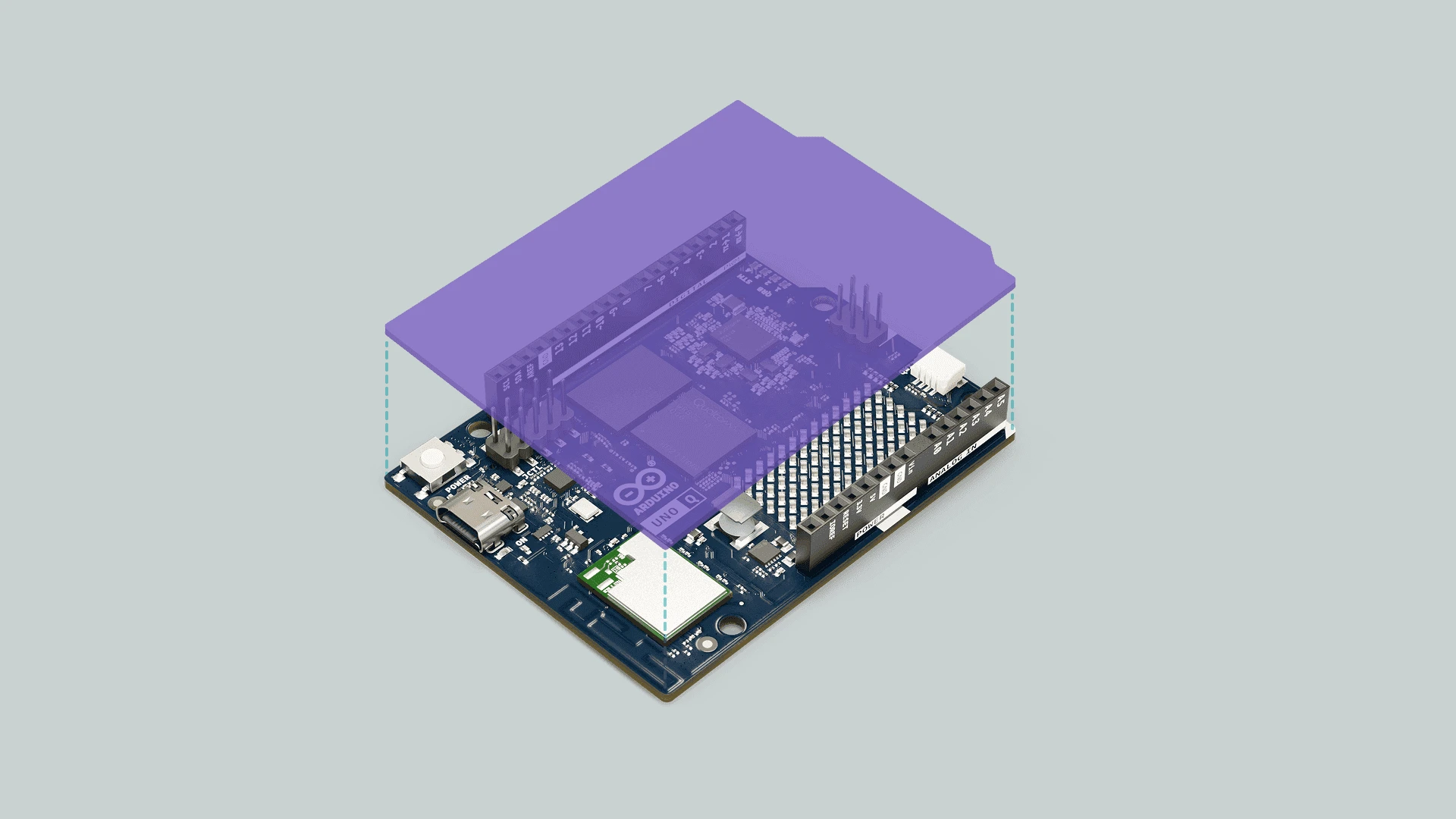
Power Supply Options
Arduino UNO Q supports multiple power supply methods, allowing you to choose the appropriate input method based on your application scenario:
- USB-C Power: Suitable for daily development, program flashing, and connection to a computer or dock, supporting up to 5V/3A input.
- 5V Pin Power: An external stable +5V DC power supply can be connected to the 5V pin to power the board.
- VIN Pin Power: Supports 7V ~ 24V input, suitable for embedded installations or with external power modules.
When the UNO Q needs to drive a display or multiple USB peripherals, it is recommended to use a USB-C dock with PD external power to ensure stable system power.
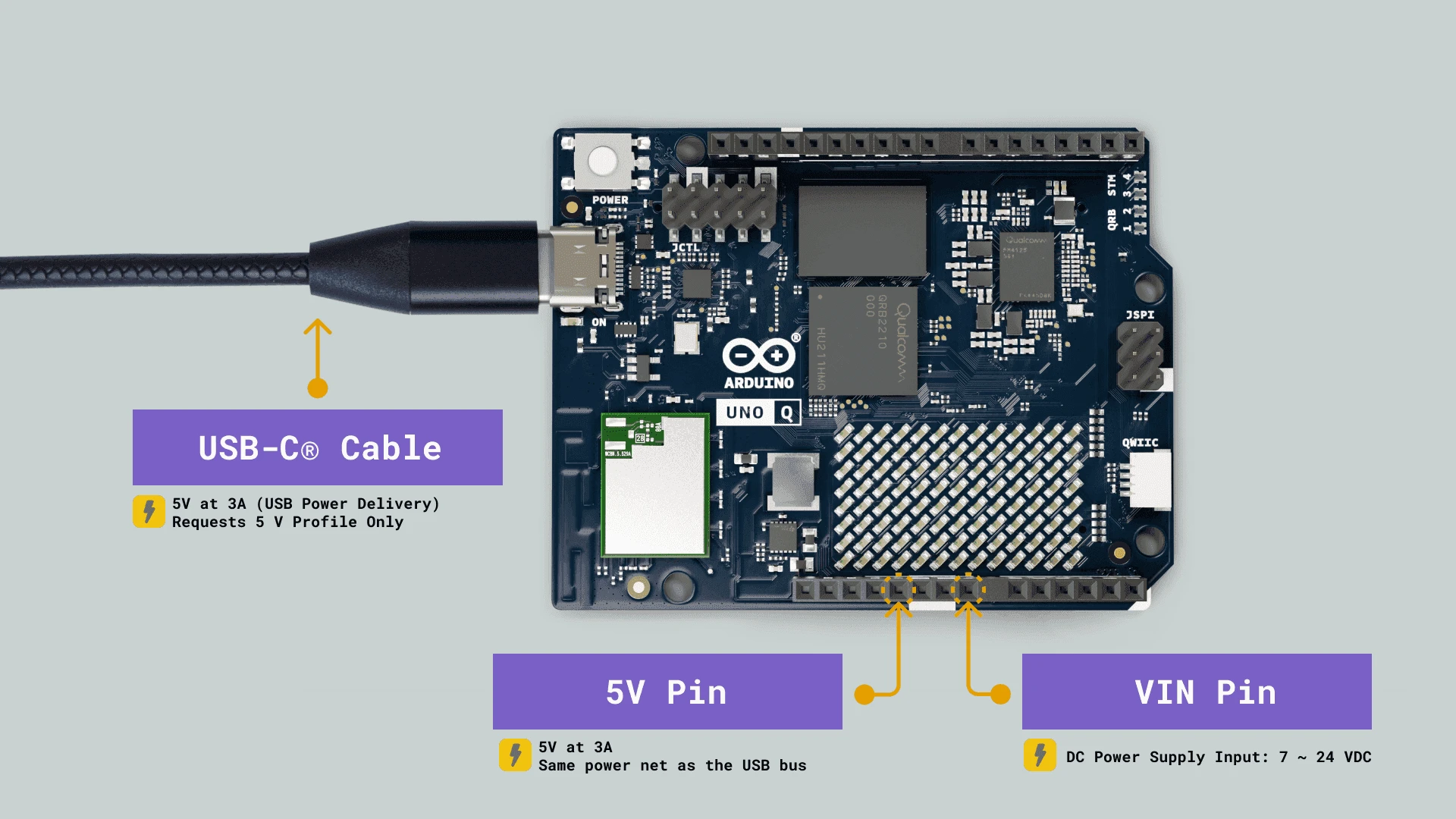
Click here for more information on UNO Q Power Specifications.