ESP32-C6-Touch-AMOLED-2.06
Product Overview
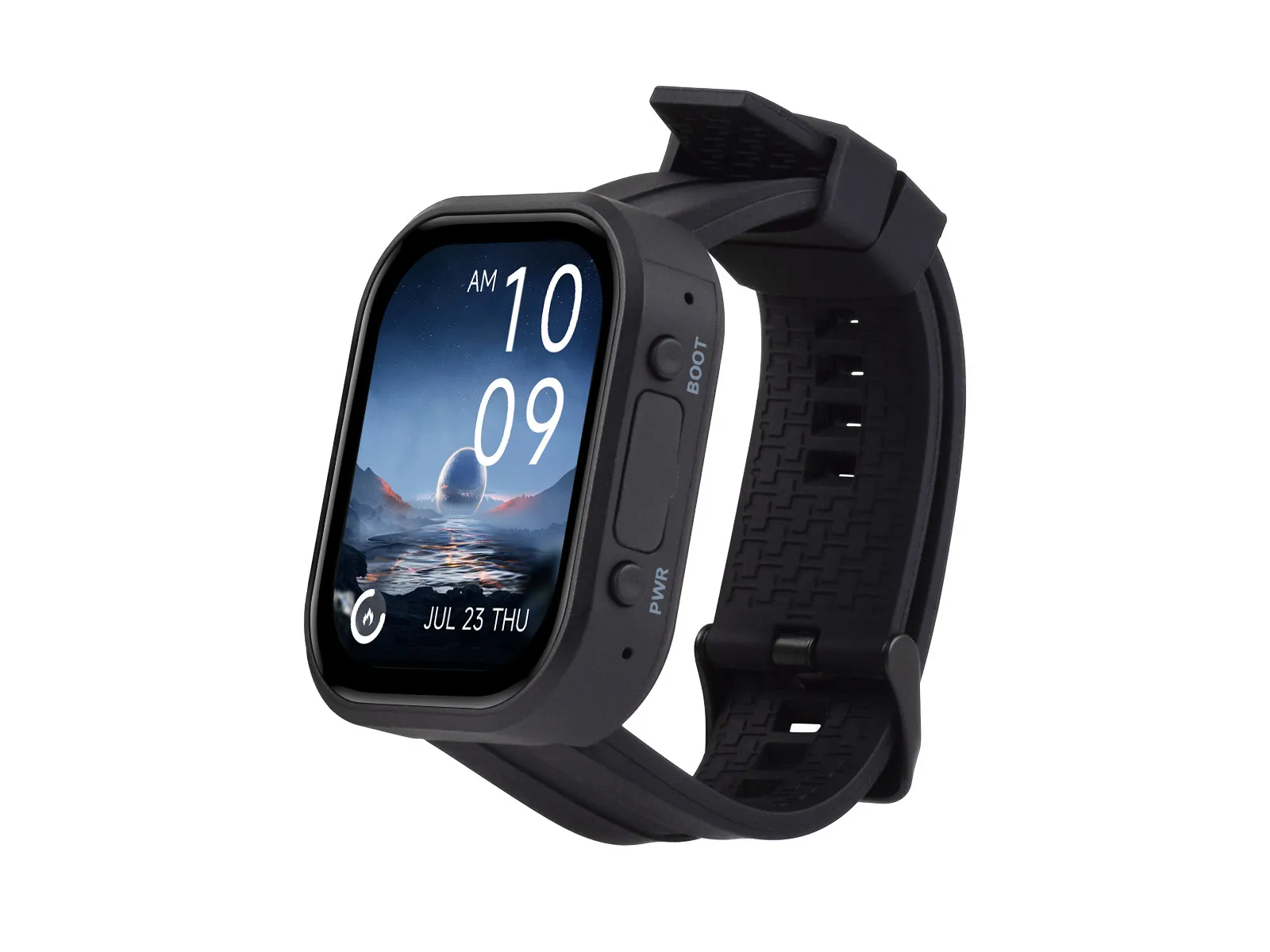
ESP32-C6-Touch-AMOLED-2.06 is a high-performance, wearable watch-shaped development board launched by Waveshare. The product is based on the ESP32-C6 microcontroller, integrating a 2.06inch capacitive touch HD AMOLED screen, a 6-axis IMU, RTC, an audio codec chip and power management and other functional modules. With a custom case, it looks and forms like a smart watch and is designed for prototyping and functional verification of wearable applications.
| SKU | Product |
|---|---|
| 32769 | ESP32-C6-Touch-AMOLED-2.06 |
| 32770 | ESP32-C6-Touch-AMOLED-2.06-EN |
Features
- Powered by the ESP32-C6 high-performance 32-bit RISC-V processor, with a main frequency of up to 160MHz
- Supports Wi-Fi 6, Bluetooth 5, and IEEE 802.15.4 (Zigbee 3.0 and Thread) wireless communication with excellent RF performance and onboard antenna
- Built-in 512KB HP SRAM, 16KB LP SRAM, and 320KB ROM, with external 16MB Flash
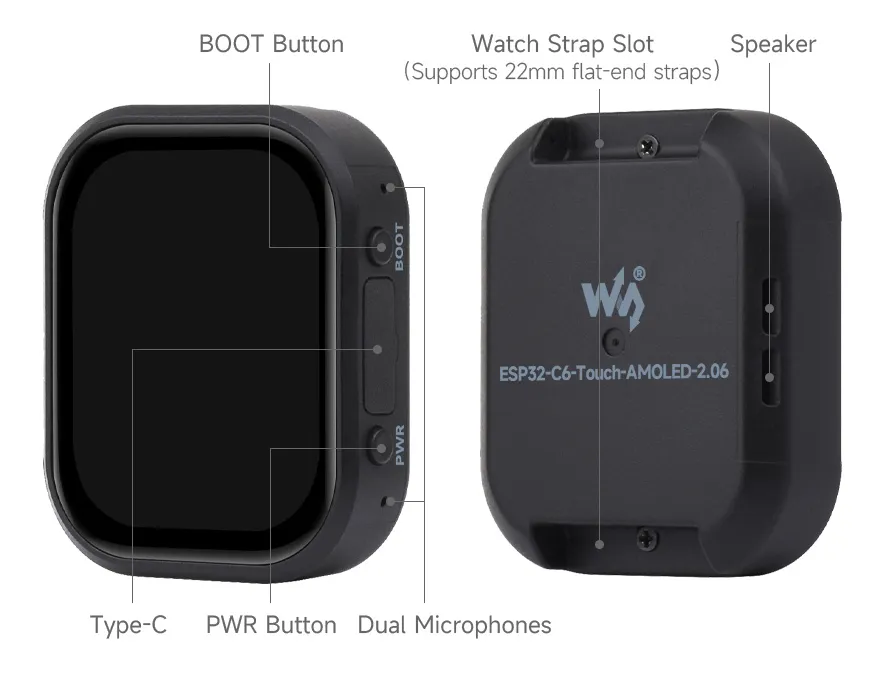
- Features a Type-C interface, enhancing user convenience and device compatibility
Hardware Description
- Onboard 2.06inch capacitive touch high‑definition AMOLED screen with 410 × 502 resolution and 16.7 million colors, capable of displaying colorful images clearly
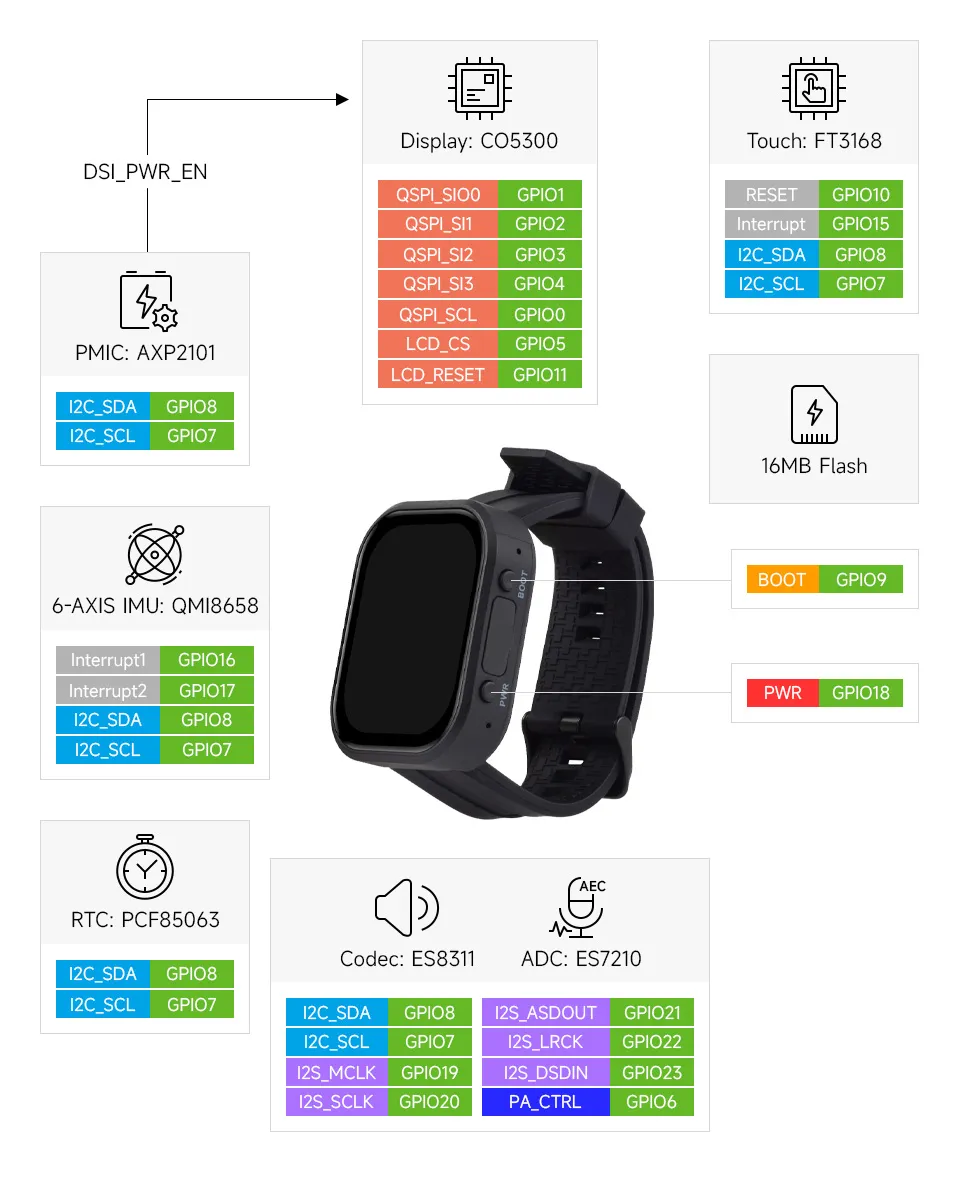
- Built-in CO5300 driver chip and FT3168 capacitive touch controller chip, communicating via QSPI and I2C interfaces respectively, minimizing the use of I/O pins
- Onboard QMI8658 6-axis IMU (3-axis accelerometer and 3-axis gyroscope) for detecting motion posture, step counting, and other functions
- Onboard PCF85063 RTC chip, powered by the AXP2101 with battery backup for uninterrupted operation
- Onboard PWR and BOOT side buttons, configurable for custom function development
- Onboard 3.7V MX1.25 lithium battery charge/discharge interface
- Exposed 1x I2C, 1x UART, and 1x USB solder pads for connecting external devices and debugging
- Benefits of using AXP2101 include efficient power management, support for multiple output voltages, charging and battery management functions, and optimized battery life
- The AMOLED screen offers higher contrast, wide viewing angles, rich colors, fast response time, slim design, low power consumption, and flexibility
Pinout Definition
Dimensions
Screen Description
Touch and Its Controller
- This touch screen is composed of tempered glass on the surface and a film layer, offering high strength, hardness, and good light transmission. It uses the FT3168 self‑capacitance touch controller, which supports the standard I2C communication protocol and allows configurable communication rates from 10kHz to 400kHz.
Battery Installation Instructions
When disassembling, special care must be taken to protect the cable area. This part is fragile; pulling, twisting, or forceful handling may cause breakage and affect device usability. Before disassembly, understand the importance of cable protection. Perform disassembly slowly and gently, observe the cable connection position and routing when separating the case from the main board, support the main board or cable to keep it in a natural, tension‑free state, and avoid forced disassembly.
Video Part 1:
Video Part 2:
Development Methods
The ESP32-C6-Touch-AMOLED-2.06 supports two development frameworks: Arduino IDE and ESP-IDF, providing flexibility for developers to choose the tool that best fits their project requirements and personal preference.
Both development methods have their own advantages. Developers can choose based on their needs and skill levels. Arduino is simple to learn and quick to start, suitable for beginners and non-professionals. ESP-IDF provides more advanced development tools and stronger control capabilities, suitable for developers with professional backgrounds or higher performance requirements, and is more appropriate for complex project development.
-
Arduino IDE is a convenient, flexible, and easy-to-use open-source electronics prototyping platform. It requires minimal foundational knowledge, allowing for rapid development after a short learning period. Arduino has a huge global user community, providing a vast amount of open-source code, project examples, and tutorials, as well as a rich library ecosystem that encapsulates complex functions, enabling developers to implement various features rapidly. You can refer to the Working with Arduino to complete the initial setup, and the tutorial also provides related example programs for reference.
-
ESP-IDF, short for Espressif IoT Development Framework, is a professional development framework launched by Espressif Systems for its ESP series of chips. It is based on C language development and includes compilers, debuggers, flashing tools, etc. It supports development via command line or integrated development environments (such as Visual Studio Code with the Espressif IDF plugin), which provides features like code navigation, project management, and debugging. We recommend using VS Code for development. For the specific configuration process, please refer to the Working with ESP-IDF. The tutorial also provides relevant example programs for reference.