ESP32-S3-AUDIO-Board
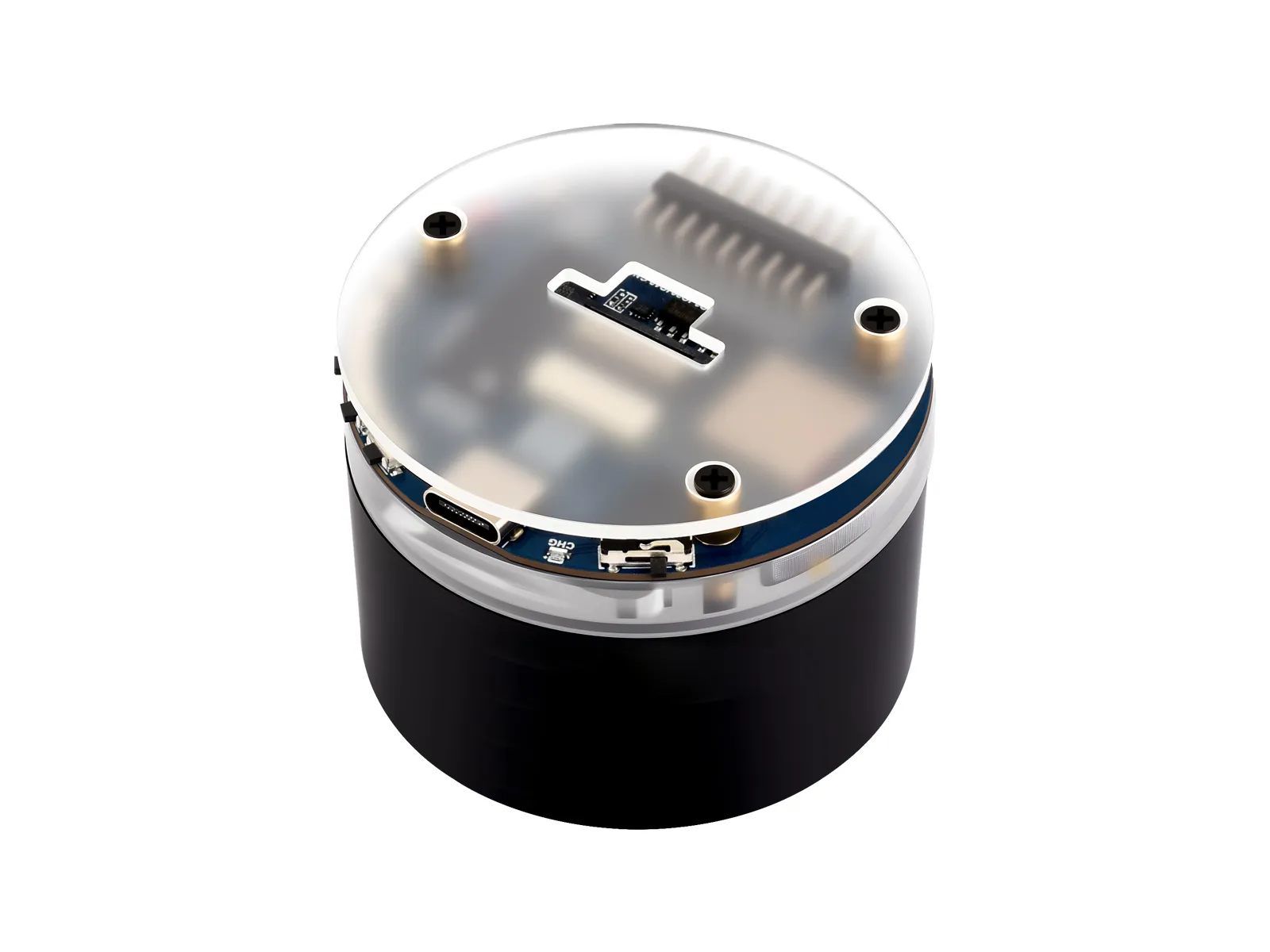
ESP32-S3-AUDIO-Board is an AI smart speaker development board based on the ESP32-S3, supporting 2.4GHz Wi-Fi and Bluetooth 5 (LE). It integrates large capacity Flash and PSRAM, features a dual-microphone array, speaker, RGB surround lighting effect, and various interfaces. It can be widely used for the rapid development of intelligent products such as AI speakers, voice interaction, HMI screen applications, and camera applications.
If you are looking for:
- Coding with AI tools: Click Ask AI and select an AI tool to ask questions about this page, or choose Copy page to copy its content and paste it into an AI tool for coding assistance.
- Schematics, datasheets, and example code: See Resources
- Arduino development: See Working with Arduino
- ESP-IDF development: See Working with ESP-IDF
- Troubleshooting: See Product FAQ or contact Technical Support
| SKU | Product |
|---|---|
| 32184 | ESP32-S3-AUDIO-Board |
| 32185 | ESP32-S3-AUDIO-Board-EN |
Features
- High-performance main controller: ESP32-S3R8, Xtensa 32-bit LX7 dual-core processor, up to 240MHz
- Wireless connectivity: Supports 2.4GHz Wi-Fi (802.11 b/g/n) and Bluetooth 5 (LE), onboard antenna
- Storage resources: 512KB SRAM, 384KB ROM, 8MB PSRAM stacked, 16MB external Flash
- Voice interaction: Dual digital microphone array, supports noise reduction and echo cancellation, suitable for precise voice recognition and near/far-field wake-up
- Clock management: Integrated PCF85063 RTC chip, supports RTC time retention when powered off, can be used for alarms, scheduled tasks, or wake-up
- Lighting effects: 7 ring RGB LEDs, programmable for various dynamic lighting effects
- Human-machine interaction: Reserved multiple buttons and battery switch for easy custom function development
- Expansion interfaces:
- SPI LCD screen interface (FPC / pin header)
- DVP camera interface (24PIN header)
- USB, I2C, and some I/Os brought out (pin-compatible with the screen interface)
- Multimedia functions: Onboard audio codec chip, MIC, and speaker interface
- Storage expansion: Supports TF card slot for storing audio files, etc.
- Power management: Built-in battery charging management module, supports multiple power modes and low-power applications
Specifications
| Parameter | Value |
|---|---|
| Interface | USB Type-C |
| Main Controller | ESP32-S3 |
| Onboard Devices | ES8311 ES7210 Mic RTC clock chip Camera interface TF Battery charge/discharge management module |
Onboard Resources
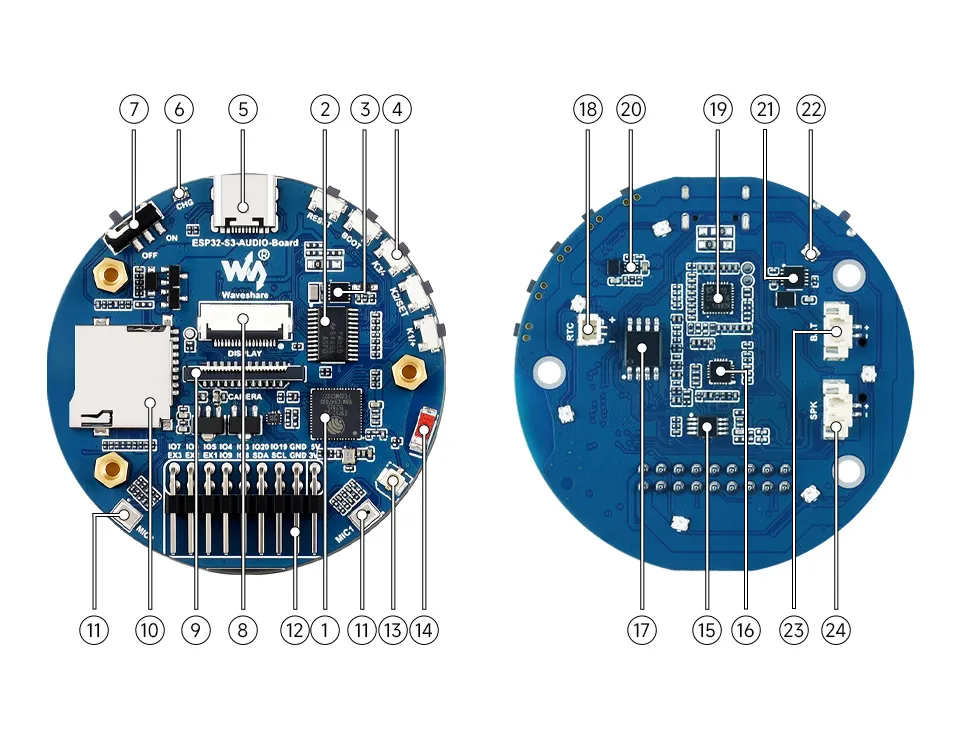
- ESP32-S3R8 Dual-core processor, operating frequency up to 240MHz
- TCA9555PWR GPIO expander chip
- RTC clock chip: PCF85063 RTC real-time clock
- Buttons RESET button, BOOT button, user-defined button
- USB Type-C port For power supply and program flashing
- Charging indicator Lights steadily when charging (with battery connected), turns off when fully charged
- System battery switch ON: connect battery; OFF: disconnect battery
- 18PIN screen interface Supports connecting screens with the corresponding pinout
- Camera interface Supports connecting cameras with the corresponding pinout
- TF card slot For connecting a TF card
- Microphone
- Pin header The GPIOs brought out to the header are already used by the screen interface
- IPEX1 connector Switching to use the external antenna via resoldering an onboard resistor
- Onboard ceramic antenna
- Power amplifier chip
- ES8311 Audio codec chip
- 16MB Flash
- RTC battery header For connecting a rechargeable RTC battery
- ES7210 Audio encoder chip
- MP1605GTF-Z Power module, supporting up to 3.3V 2A output
- Battery charging management chip
- RGB LEDs 7 circular surrounding RGB lights
- Battery header MX1.25 2PIN connector for 3.7V lithium battery, supports charging and discharging
- Speaker header
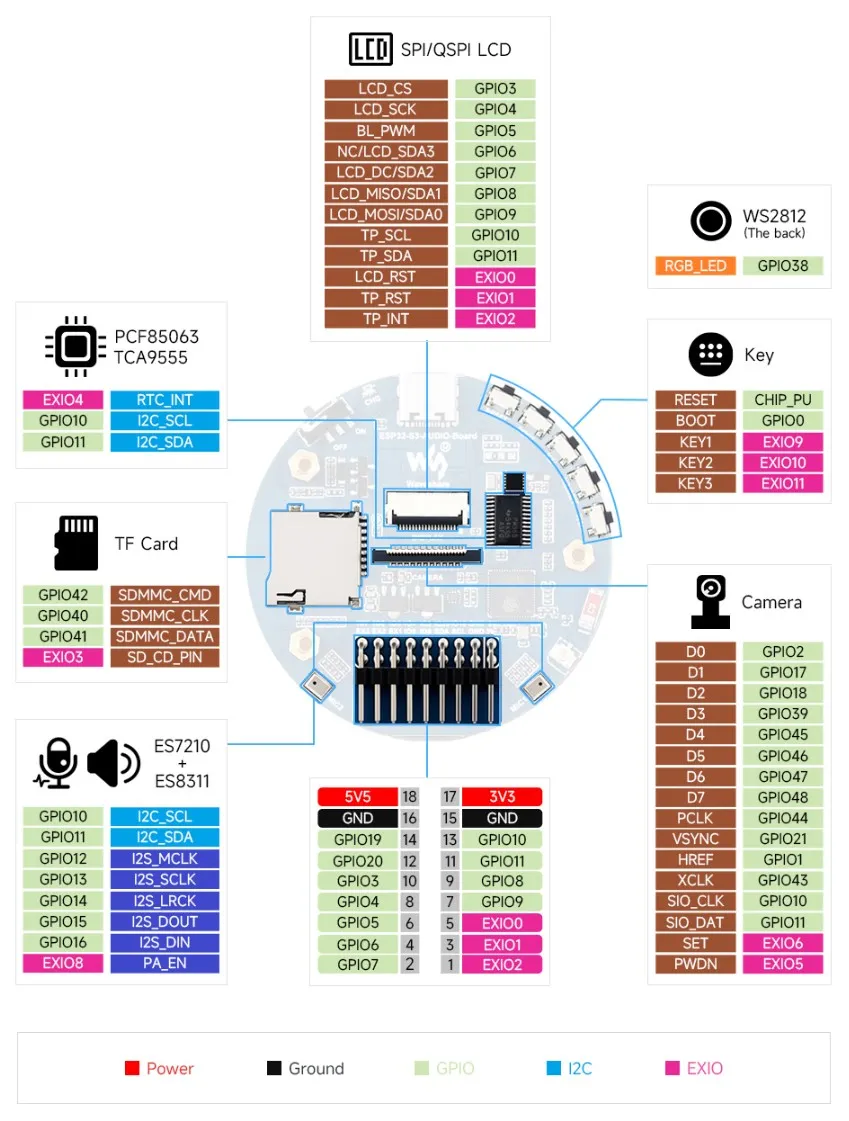
Interface Definition
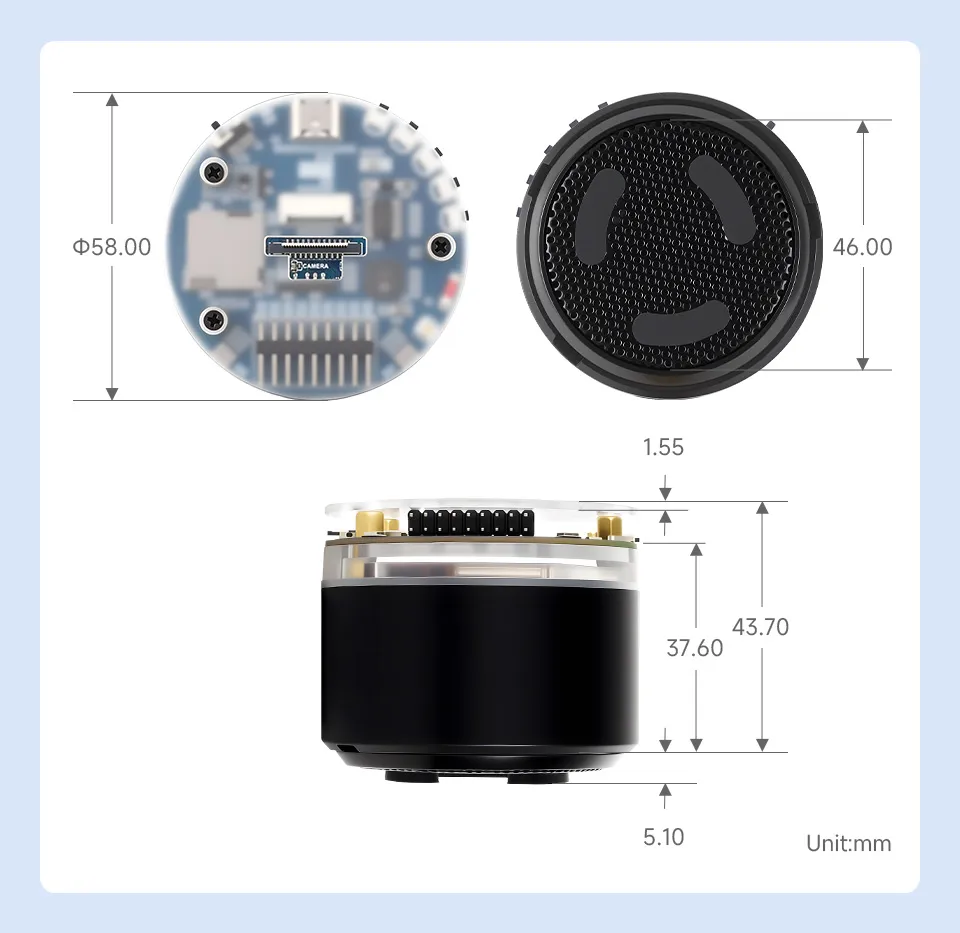
Dimensions
Development Methods
The ESP32-S3-AUDIO-Board supports two development frameworks: Arduino IDE and ESP-IDF, giving developers flexible options. You can choose the appropriate development tool based on project requirements and personal preference.
Arduino generally offers a gentler learning curve and may be more approachable for beginners and hobbyists. ESP-IDF provides advanced tooling and finer control over system behavior, making it better suited to complex projects and applications with demanding performance requirements.
-
Arduino IDE is a convenient, flexible, and easy-to-use open-source electronics prototyping platform. It requires minimal foundational knowledge, allowing for rapid development after a short learning period. Arduino has a huge global user community, providing a vast amount of open-source code, project examples, and tutorials, as well as a rich library ecosystem that encapsulates complex functions, enabling developers to implement various features rapidly. You can refer to the Working with Arduino to complete the initial setup, and the tutorial also provides related example programs for reference.
-
ESP-IDF, short for Espressif IoT Development Framework, is a professional development framework launched by Espressif Systems for its ESP series of chips. It is based on C language development and includes compilers, debuggers, flashing tools, etc. It supports development via command line or integrated development environments (such as Visual Studio Code with the Espressif IDF plugin), which provides features like code navigation, project management, and debugging. We recommend using VS Code for development. For the specific configuration process, please refer to the Working with ESP-IDF. The tutorial also provides relevant example programs for reference.