Working with Arduino
This chapter contains the following sections. Please read as needed:
Arduino Getting Started
New to Arduino ESP32 development and looking for a quick start? We have prepared a comprehensive Getting Started Tutorial for you.
- Section 0: Getting to Know ESP32
- Section 1: Installing and Configuring Arduino IDE
- Section 2: Arduino Basics
- Section 3: Digital Output/Input
- Section 4: Analog Input
- Section 5: Pulse Width Modulation (PWM)
- Section 6: Serial Communication (UART)
- Section 7: I2C Communication
- Section 8: SPI Communication
- Section 9: Wi-Fi Basics
- Section 10: Web Server
- Section 11: Bluetooth
- Section 12: LVGL GUI Development
- Section 13: Comprehensive Project
Note: This tutorial uses the ESP32-S3-Zero as a reference example, and all hardware code is based on its pinout. Before you start, we recommend checking the pinout of your development board to ensure the pin configuration is correct.
Setting Up the Development Environment
1. Installing and Configuring the Arduino IDE
Please refer to the tutorial Installing and Configuring Arduino IDE to download and install the Arduino IDE and add ESP32 support.
2. Installing Libraries
- When installing Arduino libraries, there are typically two methods: Install Online and Install Offline. If the library installation requires Install Offline, you must use the provided library file.
- For most libraries, users can easily search for and install them via the Arduino IDE's online Library Manager. However, some open-source or custom libraries are not synchronized to the Arduino Library Manager and therefore cannot be found through online search. In this case, users can only install these libraries manually via offline methods.
The example program package for the ESP32-S3-LCD-2 development board can be downloaded from here. The
Arduino\librariesdirectory within the package already contains all the library files required for this tutorial.
| Library/File Name | Description | Version | Installation Method |
|---|---|---|---|
| LVGL | Graphics library | v8.4.0 | "Online installation" (requires copying the demos folder to src) |
| GFX_Library_for_Arduino | LCD driver library | v1.5.0 | "Online Installation" |
| FastIMU | IUM driver library | v1.2.6 | "Online Installation" |
| OneButton | Button driver library | v2.6.1 | "Online Installation" |
There are strong dependencies between versions of LVGL and its driver libraries. For example, a driver written for LVGL v8 may not be compatible with LVGL v9. To ensure that the examples can be reproduced reliably, it is recommended to use the specific versions listed in the table above. Mixing different versions of libraries may lead to compilation failures or runtime errors.
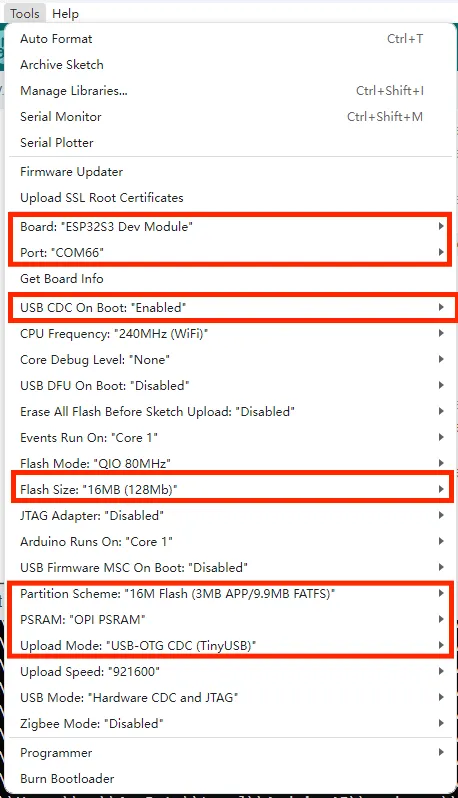
3. Arduino Project Parameter Settings
Example
The Arduino examples are located in the Arduino/examples directory of the example package.
| Example | Basic Program Description | Dependency Library |
|---|---|---|
| 01_factory | Comprehensive test program | lvgl, GFX_Library_for_Arduino, FastIMU, OneButton |
| 02_gfx_helloworld | Display HelloWorld on the screen | GFX_Library_for_Arduino |
| 03_sd_card_test | Test TF card | - |
| 04_qmi8658_output | Print QMI8658 data over serial | FastIMU |
| 05_lvgl_qmi8658 | Display QMI8658 data using LVGL | lvgl, FastIMU |
| 06_lvgl_battery | Display battery voltage using LVGL | lvgl, GFX_Library_for_Arduino |
| 07_lvgl_brightness | Control and display screen brightness using LVGL | lvgl, GFX_Library_for_Arduino |
| 08_lvgl_example | LVGL example program | lvgl, GFX_Library_for_Arduino |
| 09_lvgl_camera | Display camera image using LVGL | lvgl, GFX_Library_for_Arduino |
| 10_camera_web_server | Display camera image on a web page |
01_factory
Example Description
- This example tests the functions of the onboard modules of the ESP32-S3-LCD-2. The screen will display information about each module, and the user can switch pages via the touchscreen.
Hardware Connection
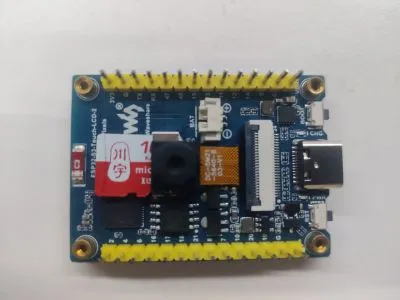
- Connect the board to the computer.
- Insert the
OV5640camera into the24Pin Camera Interfaceon the board (the camera is optional; other functions are not affected). - Insert the TF card into the card slot (optional; other functions are not affected).
Code Analysis
-
Hardware Initialization
Serial.begin(115200);bsp_i2c_init(); //Initialize I2C bus, commonly used to connect sensors, displays, etc.bsp_lv_port_init(); //Initialize the LVGL graphics library port to output graphics to display devices such as LCDbsp_spi_init(); //Initialize SPI bus, commonly used for communication with sensors, external storage, screens, etc. -
LVGL graphics library configuration
bsp_lv_port_run(); //Run LVGL-related drivers or loops, such as refreshing the display, etc.if (lvgl_lock(-1)) { //Lock LVGL resources to ensure they do not conflict with other tasks when updating the UIlvgl_ui_init(); //Initialize UI, possibly including layout and control settingslvgl_unlock(); //Unlock LVGL, allowing other tasks to access LVGL} -
Peripheral initialization
app_qmi8658_init(); //Initialize QMI8658 sensor (such as accelerometer, gyroscope, etc.)app_system_init(); //Perform system-level initialization, such as clock, memory, reset, etcapp_camera_init(); //Initialize the camera module, prepare for image captureapp_wifi_init(sta_ssid, sta_pass); //Initialize Wi-Fi module, connect to specified Wi-Fi network -
Application layer task execution
app_qmi8658_run(); //Start QMI8658 sensor-related tasks, such as data acquisition, processing, etc.app_system_run(); //Start system tasks to ensure that system functions are running properlyapp_camera_run(); //Start camera-related tasks, usually to obtain image data and process or transmit itapp_wifi_run(); //Start Wi-Fi related tasks, such as connection management, data transmission, etc.
Operation Result
-
Single-click BOOT button: down; double-click BOOT button: up; long-press BOOT button: confirm.
-
System interface

-
QMI8658 interface, showing acquired X, Y, Z axis acceleration and angular velocity data.

-
Camera interface, showing the image captured by the camera.

-
Wi-Fi interface, displaying the Wi-Fi name and password to connect; after successful connection, the IP address is shown.

02_gfx_helloworld
Example Description
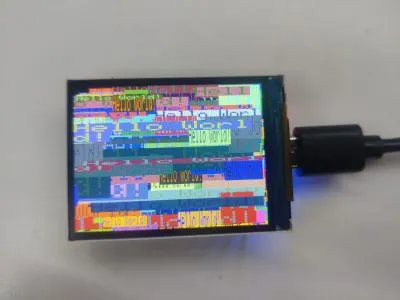
- This example demonstrates the ESP32-S3-LCD-2 using the GFX_Library_for_Arduino library to drive the screen and display "HelloWorld".
Hardware Connection
- Connect the board to the computer.
Code Analysis
-
Create an Arduino_ESP32SPI object
busto configure the SPI bus GPIOs, and create an Arduino_ST7789 objectgfxto drive the ST7789 display.Arduino_DataBus *bus = new Arduino_ESP32SPI(EXAMPLE_PIN_NUM_LCD_DC /* DC */, EXAMPLE_PIN_NUM_LCD_CS /* CS */,EXAMPLE_PIN_NUM_LCD_SCLK /* SCK */, EXAMPLE_PIN_NUM_LCD_MOSI /* MOSI */, EXAMPLE_PIN_NUM_LCD_MISO /* MISO */);/* More display class: https://github.com/moononournation/Arduino_GFX/wiki/Display-Class */Arduino_GFX *gfx = new Arduino_ST7789(bus, EXAMPLE_PIN_NUM_LCD_RST /* RST */, EXAMPLE_LCD_ROTATION /* rotation */, true /* IPS */,EXAMPLE_LCD_H_RES /* width */, EXAMPLE_LCD_V_RES /* height */);
Operation Result
03_sd_card_test
Example Description
- This example demonstrates testing TF card read/write functionality on the ESP32-S3-LCD-2.
Hardware Connection
- Connect the board to the computer.
- Insert the TF card into the card slot (the TF card needs to be formatted as FAT32).
Code Analysis
-
SPI interface initialization and TF card initialization.
SPI.begin(sck, miso, mosi, cs);if (!SD.begin(cs)) {Serial.println("Card Mount Failed");return;}
Operation Result
-
Open the serial monitor
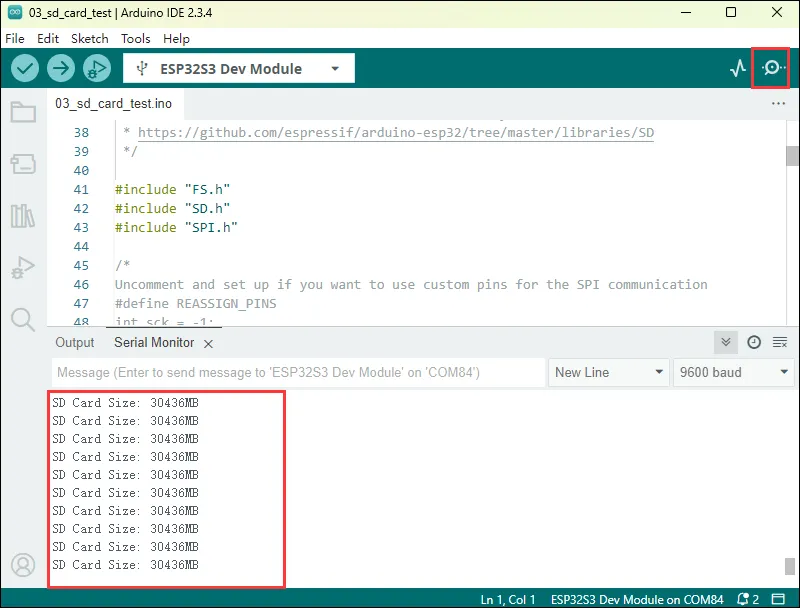
-
Insert the TF card into the computer, and and two files, test.txt and foo.test, will appear. The content of the foo.txt is Hello World!, and the test.txt is empty.

04_qmi8658_output
Example Description
- This example demonstrates reading QMI8658 data on the ESP32-S3-LCD-2 and printing it over the serial port.
Hardware Connection
- Connect the board to the computer.
Code Analysis
-
Initialize the QMI8658.
int err = IMU.init(calib, IMU_ADDRESS);if (err != 0) {Serial.print("Error initializing IMU: ");Serial.println(err);while (true) {;}}
Operation Result
-
Open the serial monitor to see printed X, Y, Z axis acceleration, gyroscope, and QMI8658 internal temperature sensor data.
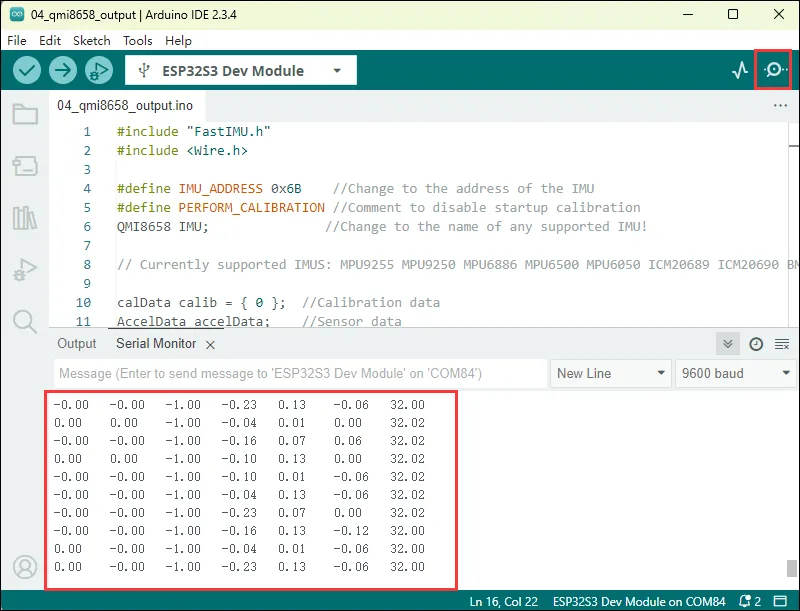
05_lvgl_qmi8658
Example Description
- This example demonstrates reading QMI8658 data on the ESP32-S3-LCD-2 and displaying it using the LVGL library.
Hardware Connection
- Connect the board to the computer.
Code Analysis
-
Initialize the UI and create a 100ms timer to obtain QMI8658 data.
lvgl_qmi8658_ui_init(lv_scr_act());
Operation Result

06_lvgl_battery
Example Description
- This example demonstrates using the LVGL library on the ESP32-S3-LCD-2 to display battery voltage and ADC values on the screen.
Hardware Connection
- Connect the board to the computer.
- Insert the battery into the battery header.
Code Analysis
-
Initialize the UI and create a 1000ms timer to obtain ADC data and convert it to voltage.
lvgl_battery_ui_init(lv_scr_act());
Operation Result

07_lvgl_brightness
Example Description
- This example demonstrates using the LVGL library on the ESP32-S3-LCD-2 to display screen brightness, with a slider to control the brightness.
Hardware Connection
- Connect the board to the computer.
Code Analysis
-
Initialize the UI and create a slider value change callback; when the slider value changes, the screen brightness is adjusted.
lvgl_brightness_ui_init(lv_scr_act());
Operation Result

08_lvgl_example
Example Description
- This example demonstrates running the LVGL example program on the ESP32-S3-LCD-2.
Hardware Connection
- Connect the board to the computer.
** Note
- If the lvgl library is installed online, you need to copy the demos folder to src.
Code Analysis
-
Select the LVGL example to run.
lv_demo_widgets();// lv_demo_benchmark();// lv_demo_keypad_encoder();// lv_demo_music();// lv_demo_stress();
Operation Result

09_lvgl_camera
Example Description
- This example displays camera images on the ESP32-S3-LCD-2 screen using the LVGL library.
Hardware Connection
- Connect the board to the computer.
- Insert the TF card into the card slot.
Code Analysis
-
Create a dedicated task to capture camera images.
xTaskCreatePinnedToCore(camera_task, "camera_task_task", 1024 * 3, NULL, 1, NULL, 0); -
Capture camera image and update the display.
camera_fb_t *pic;lv_img_dsc_t img_dsc;img_dsc.header.always_zero = 0;img_dsc.header.w = 480;img_dsc.header.h = 320;img_dsc.data_size = 320 * 480 * 2;img_dsc.header.cf = LV_IMG_CF_TRUE_COLOR;img_dsc.data = NULL;// lv_img_set_src(img_camera, &pic);while (1){pic = esp_camera_fb_get();if (NULL != pic){img_dsc.data = pic->buf;if (lvgl_lock(-1)){lv_img_set_src(img_camera, &img_dsc);lvgl_unlock();}}esp_camera_fb_return(pic);vTaskDelay(pdMS_TO_TICKS(1));}
Operation Result

10_camera_web
Example Description
- This example demonstrates how to drive the camera using the ESP32-S3-LCD-2. After connecting to Wi-Fi, the program creates a web server. Users simply enter the device's IP address in a browser to access it. The web page can display the camera image and supports settings such as resolution and mirroring.
Hardware Connection
- Connect the board to the computer.
- Insert the
OV5640camera into the24Pin Camera Interfaceon the board.
Code Analysis
- Wi-Fi SSID to connect to
char sta_ssid[] = "waveshare";
-
Wi-Fi password to connect to
char sta_pass[] = "12345678";
Operation Result
-
Open the serial terminal; after connecting to Wi-Fi, the IP address is shown.
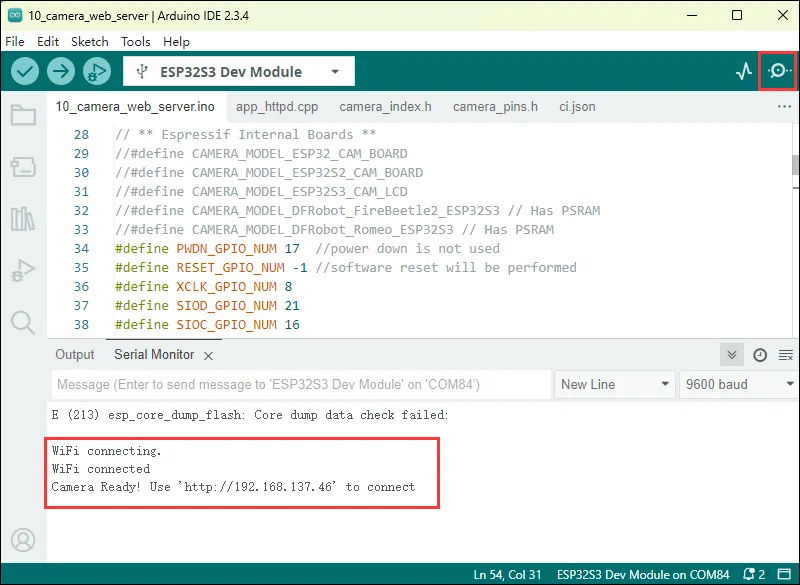
-
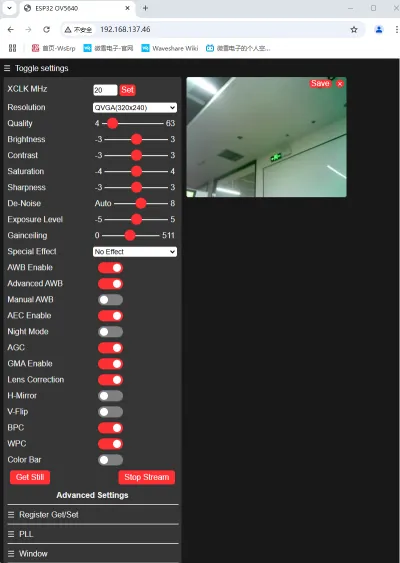
Enter the IP address printed on the serial port in a browser.
-
Click "Start Stream" to see the camera image.