ESP32-S3-LR1121-ePaper-2.9
- ESP32-S3-LR1121-ePaper-2.9-HF
- ESP32-S3-LR1121-ePaper-2.9-LF


If you are looking for:
- Schematics, datasheets, and example code: See ESP32-S3-LR1121-ePaper-2.9 Resources and Documents.
- Power supply, button, antenna, and display notes: See Instructions for Use.
- Arduino development: See Working with Arduino.
- ESP-IDF development: See Working with ESP-IDF.
- Flashing or troubleshooting: See Firmware Flashing and FAQ.
Product Overview
ESP32-S3-LR1121-ePaper-2.9 is a development board that integrates the ESP32-S3, the LR1121 wireless module, and a 2.9-inch e-paper display. It features an onboard RTC real-time clock, fuel gauge, TF card slot, RGB LED, and expansion interface, and provides Arduino and ESP-IDF examples. It can be used to develop electronic labels, device status signs, and battery-powered information display terminals.
| SKU | Product |
|---|---|
| 36047 | ESP32-S3-LR1121-ePaper-2.9-HF |
| 36048 | ESP32-S3-LR1121-ePaper-2.9-LF |
Features
- Uses the ESP32-S3-WROOM-1-N16R8 module, equipped with an Xtensa 32-bit LX7 dual-core processor with a clock speed of up to 240 MHz, and 16 MB Flash and 8 MB PSRAM.
- Supports 2.4 GHz Wi-Fi and Bluetooth 5 (LE).
- Features a 2.9-inch e-paper display with a resolution of 296 × 128 and 4-level grayscale support; it requires no backlight and retains the image after refresh, making it suitable for infrequently updated content.
- Onboard Core1121-XF wireless module, using the LR1121 chip, supporting LoRa, (G)FSK, and LR-FHSS modulation, and suitable for low-power, long-range wireless communication.
- Onboard PCF85063A RTC and AXP2602 fuel gauge, capable of reading time and battery information.
- Onboard TF card slot, which expands local storage capacity for saving images, logs, and other files, facilitating data logging and offline content updates.
- Provides BOOT, RESET, and KEY buttons and a WS2812B RGB LED.
- Provides a USB Type-C download interface, a lithium battery connector, and a 14 Pin expansion interface.
- Supports main controller deep sleep and peripheral sleep control; the accompanying examples include timed wake-up and BOOT button wake-up.
Product Specifications
| Item | Parameter | Item | Parameter |
|---|---|---|---|
| Display Panel | E Ink screen | Display Colors | Black and white |
| Operating Voltage | 5 V | Sleep Power Consumption | 36.5 μW |
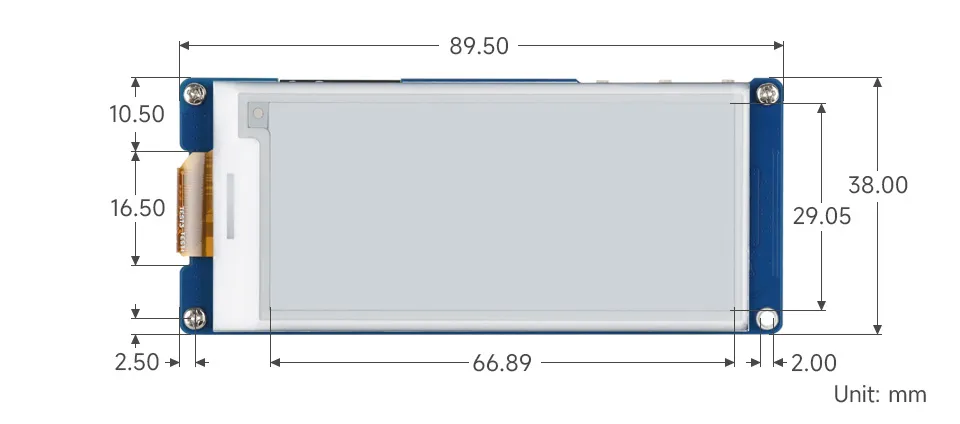
| Display Size | 66.89 × 29.05 mm | Grayscale Levels | 4 |
| Resolution | 296 × 128 pixels | Global Refresh | 3 s |
| Viewing Angle | > 170° | Partial Refresh | 0.6 s |
| Dot Pitch | 0.226 × 0.227 mm | Signal Modulation | LoRa, (G)FSK, LR-FHSS |
The HF version operates in the 850–930 MHz band, and the LF version operates in the 410–510 MHz band. When using it, select an antenna that matches the RF version and operating band.
Sleep power consumption test conditions: 3 V power supply, running the deep sleep program, with all peripheral power supplies turned off.
Resource Introduction
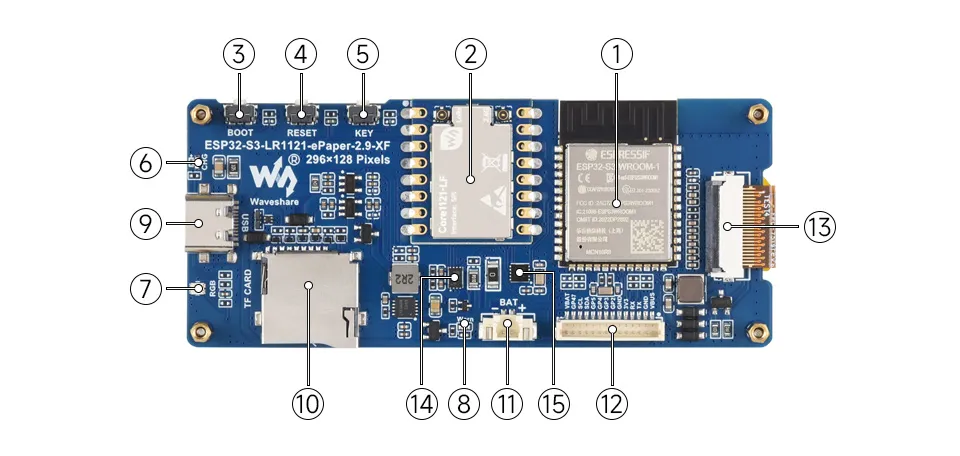
- ESP32-S3-WROOM-1-N16R8: Wi-Fi and Bluetooth SoC module, with an operating frequency of up to 240 MHz, integrating 8 MB PSRAM and 16 MB Flash.
- Core1121-XF: LoRa wireless module.
- BOOT Button: Hold BOOT and power on again to enter download mode.
- RESET Button: Restart the system.
- KEY User Button: Customizable function.
- Charging Indicator Light: Lights up while the battery is charging and turns off when charging is complete.
- WS2812B: RGB full-color programmable indicator light.
- Battery Reverse Connection Indicator Light: Lights up when the battery is connected in reverse; disconnect the external power supply before connecting or removing the battery.
- Type-C Interface: Used for power supply, program download, and serial debugging.
- TF Card Slot: Used to insert a TF card to expand storage capacity.
- MX1.25 Lithium Battery Connector (Reverse): MX1.25 2PIN connector, can connect a 3.7 V lithium battery, and supports charging and battery power supply; confirm the connector wire order and polarity before connecting.
- SH1.0 14PIN Connector: Exposes power supply, UART, I2C, and GPIO signals.
- 2.9-inch E Ink Screen Interface: Used to connect the accompanying e-paper screen.
- AXP2602: Coulomb counter, capable of reading battery information; it does not handle charging management.
- PCF85063: RTC clock chip, supporting time-keeping function.
Pin Definition
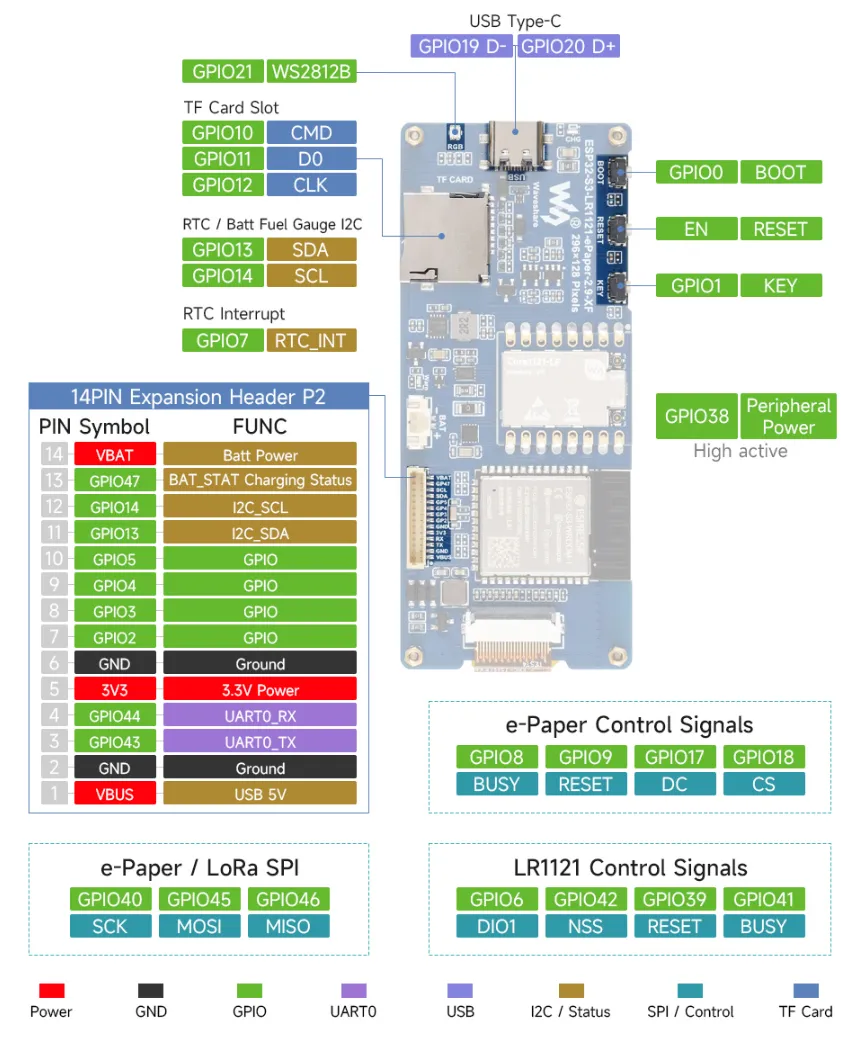
The figure below shows the pin definitions of the onboard peripherals and the SH1.0 14PIN expansion interface. In the front view of the board, the USB interface faces up.
Product Dimensions
Development Approaches
- Working with Arduino: Arduino IDE configuration, library installation, board parameters, and 13 examples.
- Working with ESP-IDF: SDK selection, board-level code generation, build and download, and 13 examples.
The example numbers of the two frameworks correspond to each other, but the configuration files, default wake-up periods, and some protocol settings differ. When switching frameworks, follow the corresponding tutorial and do not directly reuse the settings of the other framework.