Modbus RTU DC Monitor
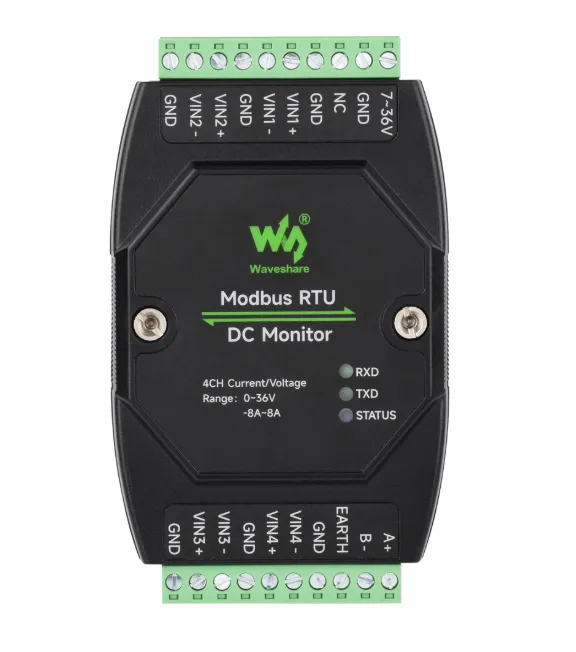
This product is an industrial-standard current and power monitoring module featuring 4-channel simultaneous acquisition. It uses the Modbus RTU protocol and allows monitoring of channel current, voltage, and power via the RS485 interface. It features built-in protection circuits including power isolation, optocoupler isolation, resettable fuse, and TVS diode.
| SKU | Product |
|---|---|
| 33931 | Modbus RTU DC Monitor |
Product Parameters
| Parameter | Description |
|---|---|
| Communication Interface | RS485 |
| Communication Baud Rate | 4800, 9600, 19200, 38400, 57600, 115200, 128000, 256000 |
| Default Communication Format | 9600, N, 8, 1 |
| Modbus Protocol | Standard Modbus RTU protocol |
| Supply Voltage | DC 7~36 V |
| Sampling Resistor | 0.002 Ω 1% |
| Voltage Measurement Range | 0 ~ 36 V |
| Current Measurement Range | ± 8 A |
| Resolution | 0.8 mA |
Indicator Light Description
| Indicator | Status Description |
|---|---|
| Status LED | Status indicator, flashes when the MCU is operating normally |
| TXD LED | Transmit indicator, lights up when transmitting data |
| RXD LED | Receive indicator, lights up when receiving data |
Hardware Interface Description
The module can measure current and voltage on four channels, each of which can operate independently. The four channels correspond to (IN1+ IN1-), (IN2+ IN2-), (IN3+ IN3-), and (IN4+ IN4-), respectively.
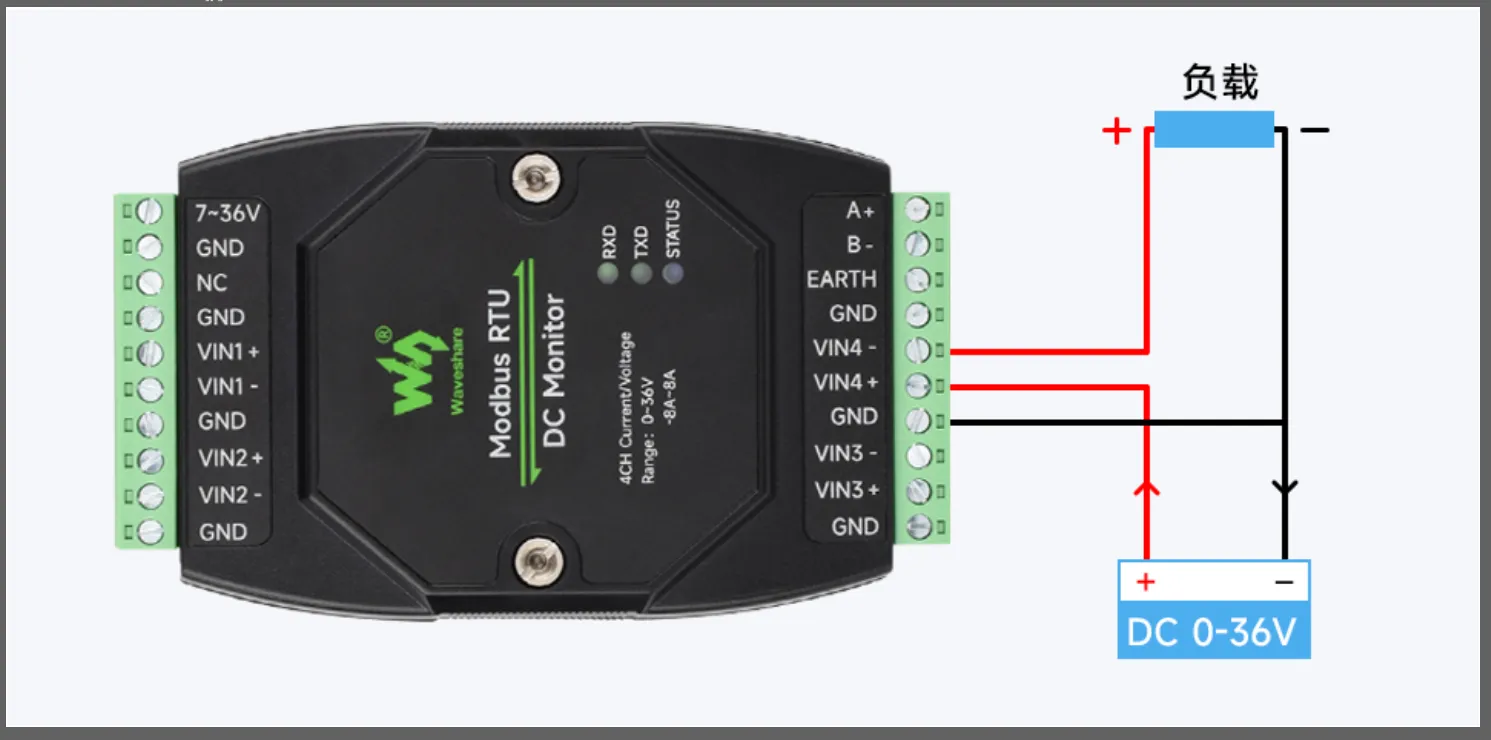
INx+ and INx- represent the current input and output, respectively. The module measures the differential voltage across the sampling resistor connected in series between INx+ and INx- to determine the current flowing through. The module can measure bidirectional current; reversing all inputs and outputs is also acceptable.
Special note: When measuring different power supplies, a common GND connection is required; otherwise, the bus voltage cannot be measured, and only the differential voltage and current can be measured.
Hardware Connection Description
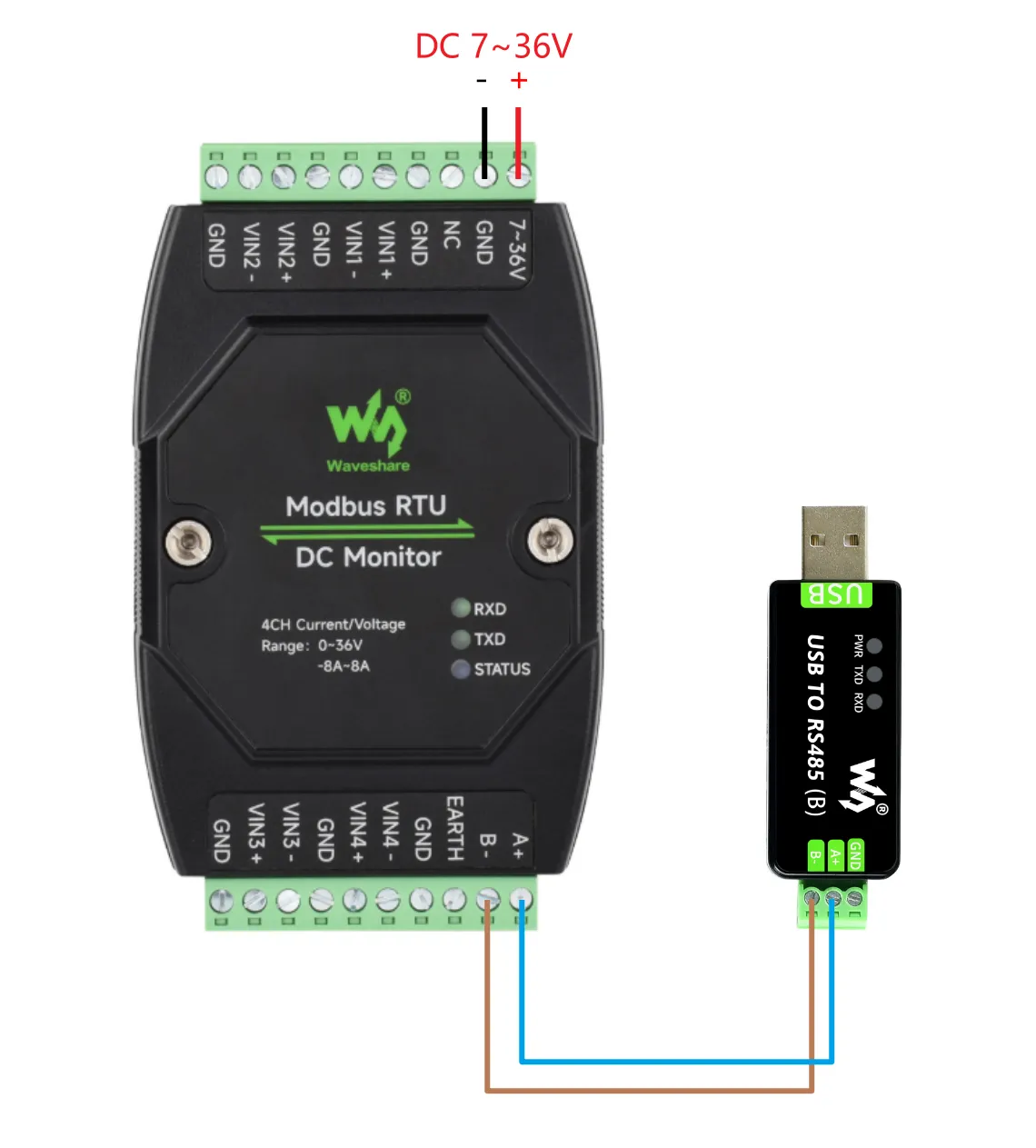
Connect the USB TO 485 converter to the target board using jumper wires, connecting A-->A and B-->B as shown in the figure below: