Thermal-USB-Camera-0502-A
| SKU | Product |
|---|---|
| 36075 | Thermal-USB-Camera-0502-A |
Product Overview
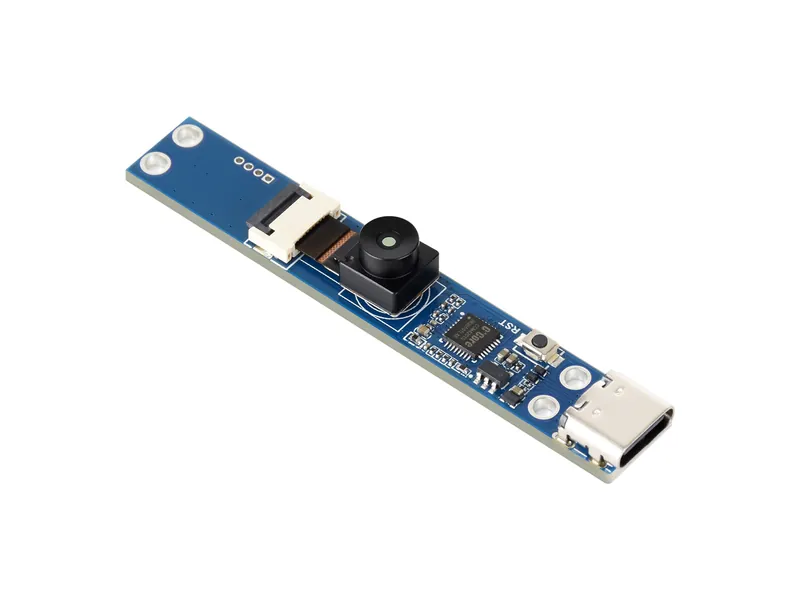
This product is a small-size infrared thermal imaging module that uses a hybrid technology of microbolometer and thermopile pixels, featuring a 50 × 50 pixel infrared array. The module can detect the distribution of infrared radiation energy of objects within the lens field of view, and after quantization processing, generates a surface temperature distribution map and thermal imaging image of the object. It has an onboard Type-C interface and can connect to host devices such as Windows computers and Android phones.
Features
- Uses a hybrid technology of microbolometer and thermopile pixels, featuring a 50 × 50 pixel infrared array
- Non-contact temperature measurement with motion detection support
- Onboard Type-C interface for connecting to Windows computers and Android phones
- Supports 25 FPS (Max) frame rate output, capable of taking photos and recording videos
- Provides mobile and PC APPs
Specifications
- Pixel Array: 50 × 50
- Field of View: 135°(D) × 79°(H) × 79°(V)
- Target Temperature Range: -20℃ to 250℃
- Detection Accuracy: ±3.5℃ (scene temperature -20℃ to 100℃)
- Refresh Rate: 25 FPS (Max)
- Operating Temperature: -20℃ to 85℃
- Operating Current: 67 mA
- Communication Interface: USB Type-C
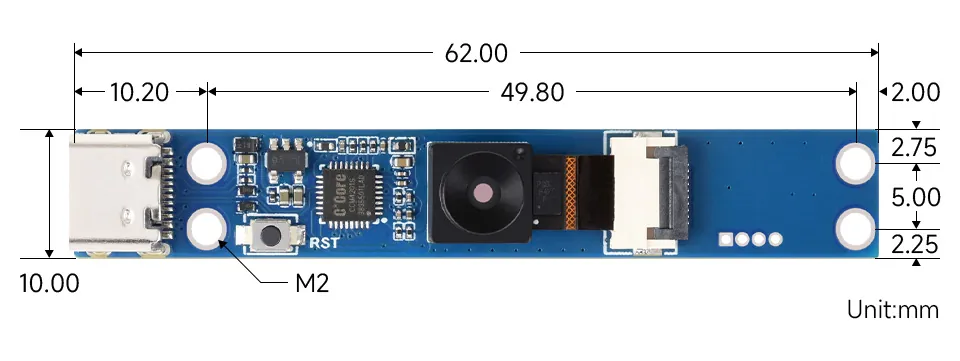
Dimensions
Temperature Measurement Principle
What is infrared temperature measurement? (Refer to OPTRIS)
In the field of measurement, "temperature" is one of the most commonly used physical parameters, second only to "time". Based on the principles of Planck and Boltzmann radiation laws, infrared thermometers determine temperature by absorbing the infrared radiation emitted by the object being measured. So how is non-contact temperature measurement achieved?
All objects with a temperature above absolute zero (0 K or -273.15℃) emit electromagnetic radiation from their surfaces, and this radiation is proportional to the object's inherent temperature. This radiation includes the infrared radiation used for temperature measurement. After this radiation passes through the atmosphere, it can be focused onto a detector with the help of a dedicated lens. The detector then generates an electrical signal proportional to this radiation. After amplification and digital signal processing, the electrical signal is converted into an output signal corresponding to the object's temperature. The measured value can be displayed on a monitor or output as a signal.
When using radiation for temperature measurement, emissivity ε (Epsilon) plays a crucial role. It indicates the relationship between the radiation of a real object and that of a blackbody. The emissivity of a blackbody is 1 (the maximum value). However, few objects can satisfy the ideal blackbody condition. When calibrating sensors, the contact surface of a radiating body is generally used (including the recommended wavelength: 0.99).
In terms of wavelength, many objects usually have a constant emissivity, but their radiating capability is far inferior to that of a blackbody. They are called gray bodies. If an object's emissivity depends on its temperature and wavelength (such as metals), such objects are called selective radiators. When measuring these two types of objects, the emissivity of the measured object must be considered when calculating the surface temperature. When using selective radiators, it is important to keep in mind the measured wavelength (for metals, choose short wavelengths).
In addition to the radiation emitted from the object's surface, the infrared sensor can also receive reflected radiation from the surrounding environment, and possibly transmitted infrared radiation from the measured object.