ESP32-P4-WIFI6-Touch-LCD-3.5
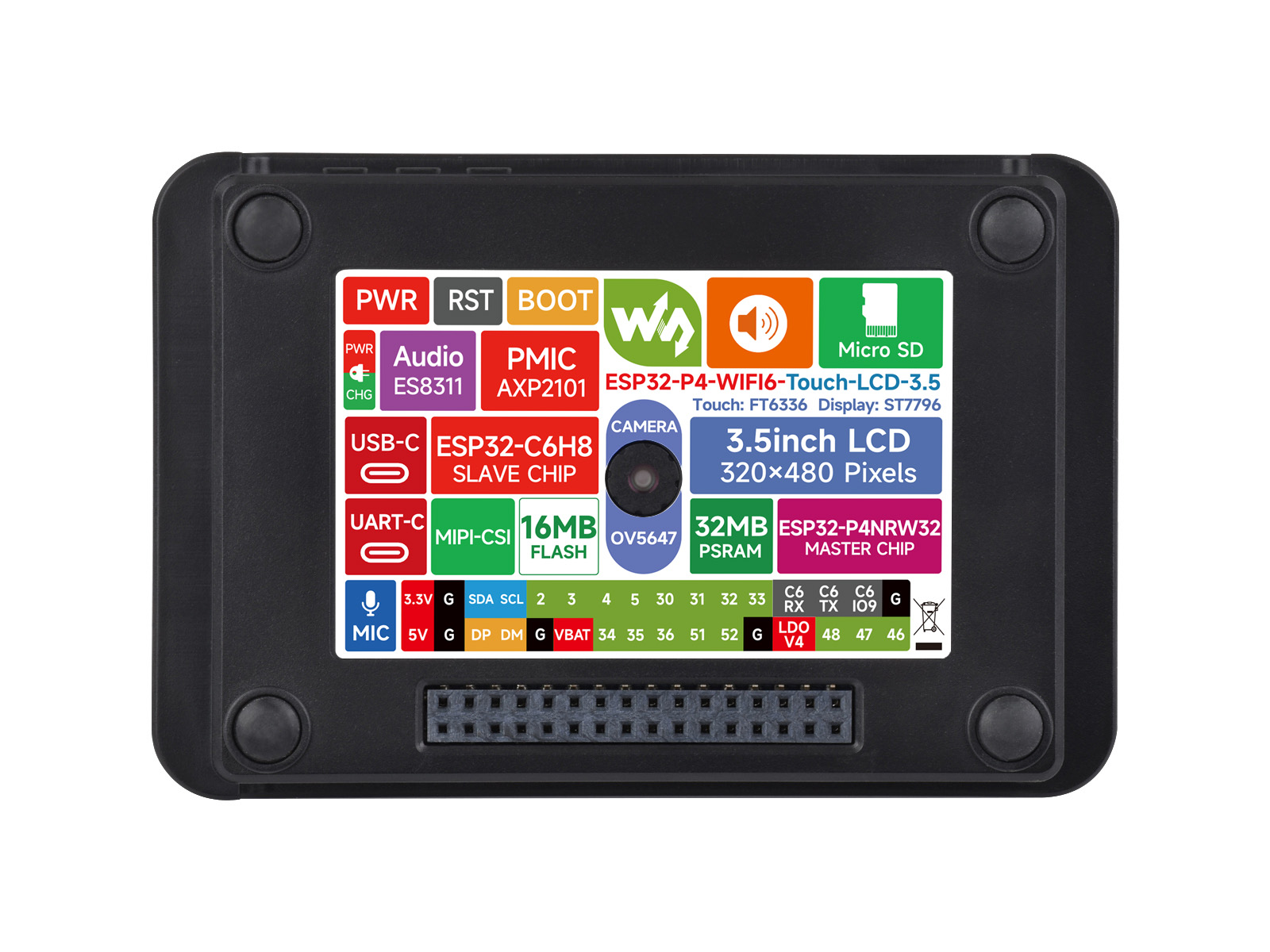
This product is a high-performance development board designed by Waveshare, based on the ESP32-P4 chip with a dual-core plus single-core RISC-V architecture. It features an onboard 3.5inch capacitive HD IPS screen, a highly integrated power management chip, and a low-power audio codec chip, among other peripherals. It supports a rich set of human-machine interaction interfaces, including MIPI-CSI (integrated with an Image Signal Processor ISP), and also supports USB OTG 2.0 HS for high-speed connectivity. The ESP32-P4 chip integrates a digital signature peripheral and a dedicated key management unit to ensure data and operational security. It is designed for high performance and high security applications, and fully meets the higher requirements of embedded applications for human-computer interface support, edge computing capabilities and IO connection features.
| SKU | Product |
|---|---|
| 33360 | ESP32-P4-WIFI6-Touch-LCD-3.5 |
| 33511 | ESP32-P4-WIFI6-Touch-LCD-3.5-EN |
Features
- High-performance MCU with RISC-V 32-bit dual-core and single-core processors
- Onboard ESP32-C6H8 Wi-Fi 6 co-processor, expanding the ESP32-P4's Wi-Fi 6 and BLE 5 functionality
- 128KB HP ROM, 16KB LP ROM, 768KB HP L2MEM, 32KB LP SRAM, and 8KB TCM
- Powerful image and voice processing capabilities; image and voice processing interfaces include JPEG codec, Pixel Processing Accelerator (PPA), Image Signal Processor (ISP), and H264 video encoder
- Stacked 32MB PSRAM inside the chip package, integrated 16MB Nor Flash outside the package
- Features a Type-C interface, enhancing user convenience and device compatibility
- Built-in 3.5inch capacitive touch high-definition IPS display with a resolution of 320×480, 262K colors for clear color pictures
- Embedded with ST7796 driver chip and FT6336 capacitive touch chip, communicating through SPI and I2C interfaces respectively, minimizes required IO pins
- Onboard PWR and BOOT side buttons, configurable for custom function development
- Onboard 3.7V MX1.25 lithium battery charge/discharge interface
- Brings out I2C, UART, USB, and multiple GPIOs for external device connection and debugging, allowing flexible peripheral function configuration
- Onboard TF card slot, providing expanded storage, fast data transfer, and flexibility, suitable for data logging and media playback, simplifying circuit design
- Onboard camera interface, supporting OV5647 and other cameras (MIPI-CSI)
- Adopts AXP2101 IC for efficient power management, supports multiple voltage outputs, battery charging, battery management, and battery life optimization, etc.
- Security mechanisms: Secure Boot, Flash encryption, hardware encryption accelerator, and hardware random number generator. It also supports hardware access protection, enabling Access Permission Management (APM) and privilege separation
Hardware Description

- ESP32-P4NRW32 ESP32-P4 with 32MB stacked PSRAM
- 16MB Nor Flash External integrated storage
- Camera Interface MIPI-CSI (2-lane), 0.5mm pitch, 15PIN
- AXP2101 Highly integrated power management chip
- Type-C Interface (USB TO UART) For power supply, programming, and debugging
- Type-C Interface (USB OTG) USB OTG 2.0 High Speed interface
- Onboard Microphones Dual microphone array input
- PWR, Charge Dual-Color LED When power is connected, it lights up red when fully charged or without a lithium battery, and lights up green when a lithium battery is charging
- Amplifier Chip Supports audio amplification output
- Speaker Header MX1.25 2PIN connector, supports 8Ω 2W speaker
- TF Card Slot SDIO 3.0 interface protocol
- IPEX 1 Connector and Onboard Chip Antenna Can be switched to use an external antenna by changing the resistor position
- PWR Button Default long press for 6s to power off, short press to power on
- RESET Button Reset button
- BOOT Button Press during power-up or reset to enter download mode
- MIPI-DSI Reserved Solder Pads Supports 0.5mm pitch, 15PIN
- ES8311 Low-Power Audio Codec Chip For audio encoding and decoding
- 2.54mm Pin Header Interface Brings out available IO function pins for easy expansion
- MX1.25 Lithium Battery Header MX1.25 2PIN connector for connecting a 3.7V lithium battery, supports charging and discharging
- ESP32-C6 SDIO interface protocol, expands ESP32-P4 with Wi-Fi 6, Bluetooth 5 (LE)
- SPI Screen Interface Supports SPI interface screens
- I2C Touch Interface Supports I2C interface touch chips
Dimensions

Development Tools
Each of these two development approaches has its own advantages, and developers can choose according to their needs and skill levels. Arduino is suitable for beginners and non-professionals because they are easy to learn and quick to get started. ESP-IDF is a better choice for developers with a professional background or high performance requirements, as it provides more advanced development tools and greater control capabilities for the development of complex projects.
ESP32-P4 currently has limited adaptation on the Arduino platform. To ensure development stability, it is recommended to use ESP-IDF for development at this stage. If you have requirements for using the Arduino platform, you can participate in the discussion on GitHub: Support of Arduino
- ESP-IDF, or full name Espressif IDE, is a professional development framework introduced by Espressif Technology for the ESP series chips. It is developed using the C language, including a compiler, debugger, and flashing tool, etc., and can be developed via the command lines or through an integrated development environment (such as Visual Studio Code with the Espressif IDF plugin). The plugin offers features such as code navigation, project management, and debugging, etc. We recommend using VS Code for development. For the specific configuration process, please refer to the Working with ESP-IDF. The tutorial also provides relevant demos for reference.